

A year ago I wrote an article called “Q4 Starts in June.” The thesis was simple: most brands start preparing for Q4 too late, and the ones that win start months earlier. That article performed well. Founders shared it. Agencies quoted it. People started their Q4 planning in June instead of August and things got better.
I stand by everything I said in that article.
But I also need to tell you that my thinking has changed significantly since then.
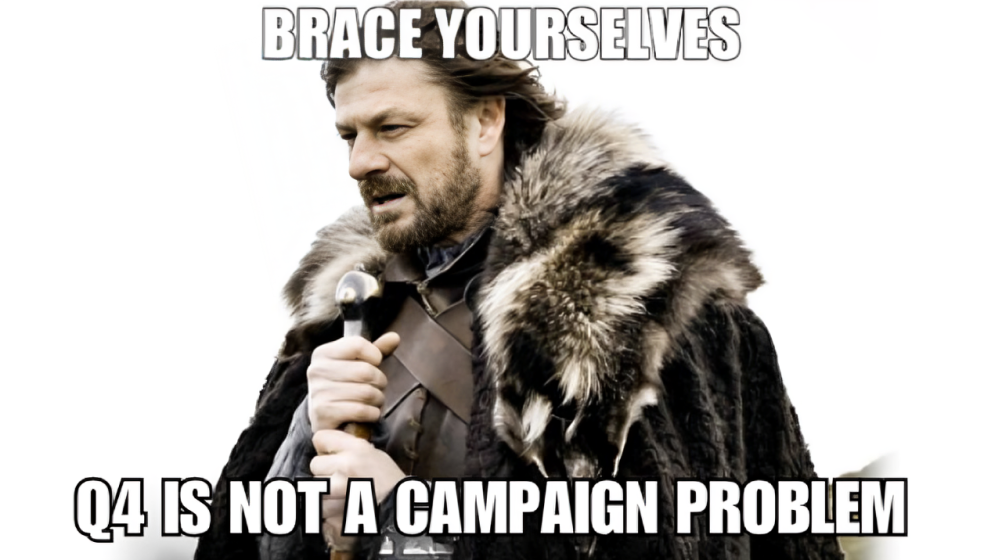
When I wrote that piece, Porcellia had about 20 people and we were managing brands spending an average of ₹15 lakhs a month. Today we have 60 people and the average brand we work with spends closer to ₹43 lakhs a month. That’s not a flex - it’s context. Because at ₹15 lakhs a month, Q4 is primarily a campaign problem. You need better creatives, smarter offers, more inventory, and tighter execution. The original article covered all of that.
At ₹50 lakhs a month, Q4 is an entirely different problem. And almost nobody is talking about what that problem actually is.
60 to 70% of annual ecommerce spending in India happens in Q4. Festive season, Diwali, end-of-year gifting - this is not a spike, it’s a structural reality of how Indian consumers spend. Data from RedSeer Strategy Consultants’ annual festive season reports and IAMAI’s ecommerce spending research consistently shows that categories like electronics, fashion, home decor, beauty, and gifting see 3–4x their monthly baseline during this window.
Sources: RedSeer “Festive Season 2024 Report”; IAMAI India Internet Report; Unicommerce Festive Season Ecommerce Trends 2023–2024.
What that means practically: if you’re doing ₹30 lakhs a month right now in June, you should be targeting ₹90 lakhs in October. A 3x lift is not aggressive ambition - it’s what the market hands you if you’re ready for it.
Not hopeful. Not optimistic. Confident - meaning you have the systems, the team, the creative inventory, the retention base, and the positioning clarity to actually deliver it. If the honest answer is no, or even maybe, this article is more relevant for you than anybody else reading it. Because the gap between where you are and where you need to be is not a campaign gap. It’s a systems gap. And closing a systems gap takes months, not weeks.
If you’re a new brand just starting out, or you’re pre-₹10 lakhs a month in spend, go read the first article. The fundamentals there are more immediately relevant for you.
But if you’re a scaling brand with real budgets, real teams, and real Q4 ambitions - read on.
I didn’t get the what wrong. I got the depth wrong.
A year ago, I believed Q4 preparation was mostly about campaigns. Make the creatives early. Plan the offers. Forecast inventory. Brief the influencers. Get ahead of the CPM spike. All of that is still true and still important.
What I underestimated - and what a year of working with larger, more complex brands has made very clear to me - is that campaigns are downstream of systems. And if your systems are broken, no campaign will save you.
Here’s the pattern I’ve watched play out more times than I can count: a brand that has been growing steadily all year hits Q4 and suddenly everything breaks at once. The email platform can’t handle the volume. The creative team is producing content but nobody knows which consumer pain points are actually driving conversion. A key hire joined in September and is still figuring things out when October hits. The influencer partnerships that seemed promising haven’t been properly evaluated. The positioning for the new product launch is being figured out in real time while CACs spike.
None of these are campaign problems. They are systems problems. And Q4 is the worst possible time to discover you have them, because peak season punishes broken systems faster and harder than any other time of year.
The brands that dominate Q4 don’t just prepare campaigns earlier. They build growth engines months in advance. And those engines take much longer to build than most founders think.
There’s something else that changed this year, and it’s accelerated everything I’m about to say.
AI has made execution dramatically easier. Content that used to take a week now takes a day. Creative variations that used to require a full production team can now be generated in hours. Workflows that used to need five people can now run with two.
On the surface, this sounds like it makes preparation easier. In reality, it makes the insight layer more valuable and more scarce than ever before.
Because if everyone can execute faster, the competitive advantage no longer lives in execution speed. It lives in knowing what to execute. Which consumer pain points are deep enough to drive real purchase decisions. Which emotional truths about your customer are so powerful that tapping into them scales infinitely. Which creators are building real demand versus just generating impressions.
AI raises the floor for everyone. The brands that win are the ones that have built systems to generate better insights faster - and then use AI to act on those insights at scale.
These are the new rules of 2026. And you cannot build that system in September - actually maybe even June is too late.
I want to be very deliberate about the word “engines” here. These are not tactics. A tactic is something you deploy. An engine is something you build, run, learn from, and improve over time. The difference matters because engines require lead time and tactics don’t.
By the time Q4 hits, each of these should already be operational and generating signal. September should be a scaling month. Not a learning month. Not a testing month. Not a building month. If you’re still constructing these in September, you’ve already lost ground.
Engine 1: Retention
The easiest way to win Q4 is to enter Q4 with thousands of customers who are already primed to buy from you again.
Most brands enter Q4 almost entirely dependent on new customer acquisition. They pour money into Meta, watch CACs spike as CPMs double, and then wonder why their Q4 economics look so different from their projections. The math is straightforward: if 80% of your Q4 revenue needs to come from new customers, you are fully exposed to whatever Meta decides to charge for attention during the most expensive advertising period of the year.
The brands that consistently win Q4 have spent the preceding months building a re-purchase engine. This means:
• Email flows that aren’t just abandoned cart sequences - actual customer journeys mapped to where someone is in their relationship with the brand
• WhatsApp as a retention channel, not just a broadcast tool
• Winback campaigns running in the background all year, so you enter Q4 with a recovered customer base rather than a lapsed one
• Replenishment sequences for consumable products, timed so customers are in an active purchase window when Q4 offers land
• Some form of loyalty mechanism - even a simple one - that gives your best customers a reason to consolidate their festive spending with you
None of this can be built in September. The flows take time to set up. The segmentation takes time to develop. And critically - you need months of data to know which of these are actually working before you scale them during peak season.
A personal care brand doing ₹400 crores a year in revenue hired us specifically to build their retention engine before Q4. The projection: 10-12% of additional top-line revenue generated entirely from retention - customers they already have, spending more, spending sooner. That’s not a small number at their scale. And it required months of infrastructure to build properly.
Engine 2: Positioning - At The Product Level
Most founders think about positioning at the brand level. That’s necessary but not sufficient. What actually determines Q4 conversion is positioning at the product level - how each individual hero SKU is framed, what desire it maps to, what narrative surrounds it.
Positioning work cannot happen during Q4. By the time the festive season hits, the story you’ve built around your products - or failed to build - is already baked into how the market perceives them. You cannot reposition a product in October. There is no time and there is no attention.
The questions that need answers right now:
• Which products are you leading with this festive season?
• For each hero SKU, what is the specific desire or fear it maps to - not the feature, the emotional truth?
• Have you validated that positioning through creative testing, or are you going in on a hunch?
• Does your product-level positioning create demand, or is it just describing what the product does?
Strong product positioning reduces dependence on discounts. Brands that enter Q4 without it face a binary choice: discount heavily to compete, or watch conversion rates suffer while better-positioned brands capture the demand. Neither is good.
We recently started working with a ₹200 crore baby care brand specifically to reposition their five hero products before the festive season. Not rebrand - reposition. The product hasn’t changed. The way it connects to what parents actually feel, fear, and want is what’s changing. That work needed to start now, because the market needs time to absorb a new narrative before it converts on it.
A ₹100 crore home decor brand brought us in to completely revamp their brand positioning and visual identity. They looked at their numbers honestly and realized that weak brand positioning was costing them on every channel - higher CACs, weaker retention, lower AOV. That work starts now so the new brand is live before Q4.
Engine 3: The Creator Engine
Most brands have creators. Almost no brands have a creator system.
There is a massive difference between running influencer campaigns and having a systematic understanding of which creators drive revenue, which drive awareness, which should be retained on longer-term partnerships, and which should quietly be let go.
Before Q4, you should have clear answers to:
• Which 20% of your creators drove 80% of your actual revenue outcomes last quarter?
• Which creators build brand affinity and which build purchase intent - and do you need both?
• Which creators are worth locking in on longer-term retainers before Q4 demand drives their prices up?
• What content formats are generating the most conversion signal from creator partnerships?
Testing and evaluating creator partnerships has to happen months before Q4 - because some partnerships will fail, and you need time to course-correct. The worst time to discover that a creator isn’t moving the needle is November, when you’ve just paid them for a Q4 campaign and there’s no time to pivot.
A multinational lifestyle brand hired us to build what I’d call a creator intelligence system - one that maps creator personas against brand thinking and creative strategy. By the time festive season hits, we know exactly which creator profiles are going to work, and we can double down on those aggressively. That system took months to build. It could not have been built in September.
Engine 4: Creative Analytics - The Consumer Insight Engine
I want to be deliberate about what this actually is, because I think most people misunderstand it.
This is not about tracking which ad had the best ROAS last week. This is about building a deep, systematic understanding of your consumer - what pain they carry, what they secretly want, what emotional truth about their life makes them stop scrolling and actually feel something.
Most brands track creatives. The best brands track consumer insights.
Here’s the practical difference. Tracking creatives means you know your winning hook or your best-performing visual. Tracking insights means you know which consumer pain points are deep enough to generate 10x the response of surface-level messaging. It means you understand which emotional truths about your customer’s life are so resonant that when you tap into them, the creative almost doesn’t matter - the idea does all the work.
When you have 300–400 ads running - which, at serious scale, you should - creative volume without a strong insight layer behind it is just noise. You’re generating signal but not learning anything. You can’t answer the question: what do we know about our consumer today that we didn’t know three months ago? What pain can we tap into 100x harder? What emotional insight have we not yet unlocked?
By September, you should already know:
• Which consumer pain points consistently drive conversion - not which hooks performed, but which underlying emotional problems your product solves that people will pay anything to fix
• Which beliefs your customer holds that, when your creative speaks to them directly, create immediate recognition and purchase intent
• Which emotional insights are powerful enough to work across multiple formats, multiple channels, multiple offers
One brand we work with was producing 100 creatives a month when they came to us. We pushed them to 300–400 a month - not because more is always better, but because at that volume, our creative analytics process generates enough data to stress-test hypotheses properly. We’re not looking for a winning ad. We’re looking for a winning insight about their consumer. That insight library is what will allow us to scale them aggressively into Q4. You cannot build it in September.
Engine 5: The Omnichannel Ecosystem
Winning brands in 2026 do not rely on Meta alone. This is not new advice, but the urgency around it is higher than it has ever been.
Meta is a demand capture channel. It is extraordinarily good at finding people who are ready to buy and showing them the right thing. But it cannot create demand from scratch, build brand affinity on its own, or retain customers.
The brands that dominate Q4 enter the season with an ecosystem that has been generating demand all year:
• Organic social that has been consistently building brand narrative and social proof
• Email and WhatsApp that have been nurturing existing customers toward repurchase
• Creator partnerships that have been building category awareness and desire
• Search presence that captures high-intent demand the moment it surfaces
• Communities, however small, where your most engaged customers have gathered
When all of these are running, Q4 Meta spend becomes a force multiplier rather than a lifeline. You’re not trying to introduce your brand to cold audiences during the most expensive CPM period of the year - you’re converting people who have already been warmed up by six months of ecosystem building.
Engine 6: The Hiring Engine
.jpg)
Nobody talks about this. But every founder has lived through it.
The mistake is hiring during peak season. Not because hiring is wrong, but because some hires will fail - and the best time to discover a bad hire is July, not October.
Think about what happens when you hire a performance marketing lead in September. They spend October getting context. They make decisions based on incomplete information. Some of those decisions are wrong. By the time you’ve figured out what’s working, it’s November and Q4 is already half over. Now imagine you made that same hire in June. By September, they’ve already had one failed experiment and learned from it. They know your brand, your benchmarks, your audience. Either they’ve proven themselves or you’ve already made a change. Either way, you enter September with a team ready to execute.
But here’s what most founders miss: this isn’t just about internal hires. It’s about every person touching your output.
If you’re producing 30 videos a month right now, you will need to produce 80 in Q4. Are you confident you can do that? If you’re currently depending on one freelance video editor, the honest answer is no. The right move is to start working with three freelancers today - give each of them 10 videos a month now, so that by Q4 you have three people who know your brand, know your style, and can each handle 25–30 videos without a drop in quality or a breakdown in turnaround.
The same logic applies to graphic designers, copywriters, UGC creators, and performance managers. Map your Q4 output requirements now and work backwards to what that means for your team and your freelancer network. Then build that network today.
The rule: any person - employee or freelancer - that you expect to be meaningfully contributing to Q4 needs to be in the workflow by July at the latest.
I want to be direct about something.
Most of the Q4 failures I have seen are not marketing failures. They are organizational failures that show up as marketing problems.
The creator partnerships weren’t evaluated early enough - organizational problem. The consumer insight system didn’t exist - organizational problem. The new hire didn’t have enough runway - organizational problem. The retention engine wasn’t built - organizational problem. The product positioning wasn’t clear - organizational problem.
None of these feel like organizational problems when you’re in the middle of Q4. They feel like execution failures, budget shortfalls, bad luck. But trace them back far enough and almost every Q4 disaster has its root in a decision - or a non-decision - made in June or July.
Growth at scale is a systems game. And systems have to be built before they are needed.
These are some of the custom growth problems our team is currently working on. I’m sharing them because I think they make the stakes real - and because each one is a different version of the same realization: Q4 is a systems problem.
• ₹200 crore baby care brand: Hired us to reposition their five hero products before festive season. Not rebrand - reposition. The work is about connecting each product to a deeper emotional truth that parents feel but that no brand in the category has claimed yet.
• ₹100 crore home decor brand: Brought us in to completely revamp their brand positioning and visual identity. Weak brand positioning was costing them on every channel - higher CACs, weaker retention, lower AOV. That work starts now so the new brand lands before Q4.
• India-market leader entering the US: Hired us to build their entire US ecosystem - testing positioning, identifying creator profiles that resonate with American consumers, figuring out what sticks before Black Friday and Christmas hit.
• Well-funded scaling brand: Brought us in to build their creative analytics infrastructure. They want to understand, at a deep level, which consumer pain points and emotional insights drive conversion. They’ve gone from 100 creatives a month to 300–400, specifically to generate enough data to find those insights before peak season.
• ₹400 crore personal care brand: Hired us to build their retention engine from scratch. Projected outcome: 15% additional top-line revenue from retention alone in Q4 - customers they already have, spending more, spending sooner.
• Multinational lifestyle brand: Hired us to build a creator intelligence system - mapping creator personas against brand strategy so that by festive season, they know exactly which creators to double down on and why.
Every one of these brands understood one thing: the window to build is now. Not August. Not September.
A year ago, we said Q4 starts in June. Today I’d go further: Q4 starts the moment you begin building the systems that power growth.
Retention systems. Creator systems. Insight systems. Product positioning. Omnichannel ecosystems. Hiring infrastructure. These cannot be built overnight.
If you’re reading this in June, there is still time to build most of them properly. If you’re reading this in August, you can still build the most important ones - but you’ll need to move fast. If you’re reading this in September and still thinking about Q4 as a campaign problem, I want to say this clearly: you are solving the wrong problem.
The brands that dominate Q4 are not running better ads. They are operating better systems. The gap between a 3x Q4 and a flat Q4 is almost never creative. It’s almost always systemic.
Every brand’s gap is different. Some need a retention engine. Some need product-level positioning work. Some need a creator intelligence system. Some need to build a consumer insight infrastructure. Some need all of it and don’t know where to start.
If you’re reading this and recognizing the gaps - i’d love to chat now (not in August pls)
In a world optimized for speed and dopamine, meaning is the only thing that lasts.
Read the full storyIn a world optimized for speed and dopamine, meaning is the only thing that lasts.
Read the full story
Get your hands on the the stuff that actually compounds.
Positioning. Retention. Content. Community.

Welcome to Finsweet's accessible modal component for Webflow Libraries. This modal uses Webflow Interactions to open and close. It is accessible through custom attributes and custom JavaScript added in the embed block of the component. If you're interested in how this is built, check out the Attributes documentation page for this modal component.
See docs