

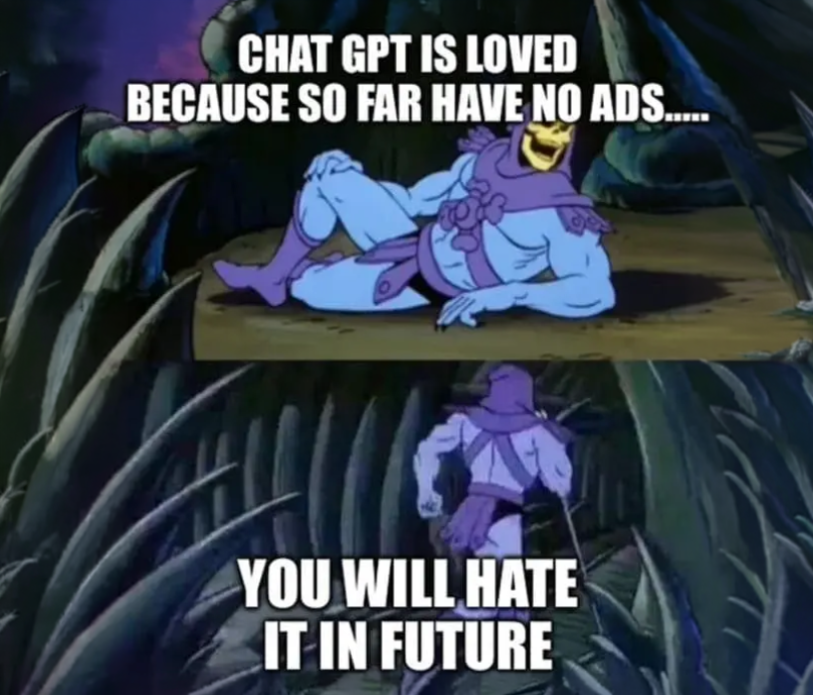
On September 7, ChatGPT ads arrived in India, and the Indian D2C ecosystem did what it always does when a new growth opportunity emerges. Founders started asking how quickly they could get access, marketers started talking about first-mover advantage, and agencies started figuring out how to sell the next big thing. Everyone wants to know how to run ChatGPT ads. Very few people are stopping to ask a much more important question: should their brand be running ChatGPT ads in the first place?
I've seen this happen with almost every new channel. When Meta ads became accessible, everyone wanted to run them. When Google Shopping grew, everyone wanted to be there. When quick commerce took off, brands started rushing to get listed, sometimes without understanding whether their margins could support the channel. The problem isn't that these channels are bad. The problem is that founders confuse the emergence of a new opportunity with the existence of an opportunity for their particular business.
At Porcellia, we've already started running ChatGPT ads for 7–8 brands, with approximately ₹15 lakh in spend across these accounts and blended ROAS of around 2×. We're experimenting, learning and figuring out where this channel fits into the acquisition mix. But one of the most important things we've learnt is that the answer cannot be the same for every brand. Some businesses have a compelling reason to test ChatGPT ads right now. Others would be better off putting that money into Meta, Google, creative production or conversion rate optimisation.
Let me explain why.
To understand whether ChatGPT ads make sense for your business, you first need to understand what makes the channel different. Meta is exceptionally good at introducing products to people who weren't necessarily looking for them. Google helps you capture demand when someone searches for a product, category or solution. ChatGPT introduces a different kind of opportunity: reaching someone while they're actively thinking through a decision, asking questions, comparing alternatives and figuring out what they should buy.
Consider two businesses. The first sells fashionable sneakers for ₹799. The second sells ergonomic chairs for ₹40,000. Both can technically advertise on ChatGPT, but the way customers buy these products is fundamentally different. Someone buying sneakers might care about the design, price, comfort and how the shoes look with their outfits. Someone buying an ergonomic chair might want to understand lumbar support, adjustability, dimensions, materials and whether the product will actually solve their problem. One purchase can be driven by discovery and impulse; the other can involve considerable research before the customer is ready to commit.
This distinction matters because ChatGPT is a conversational environment. A person asking for help choosing an ergonomic chair is already telling you what they care about, what constraints they have and what they need to understand before buying. If your product is genuinely suited to that situation, appearing in that conversation can be valuable. But if your product is largely purchased because someone sees an attractive creative and likes what they see, there may be much less reason to prioritise a conversational channel over the platforms already doing that job well.
The opportunity isn't that ChatGPT is a new place to advertise. The opportunity is that it changes the context in which your product can be discovered. And whether that context matters depends on the product you're selling, the problem you're solving and the way your customers make purchasing decisions.
I would start by looking at how much thinking happens between someone discovering your product and deciding to buy it. Some products require very little consideration. A customer sees a T-shirt they like, finds the price reasonable and purchases it. A customer buying a premium mattress, an expensive appliance or a piece of ergonomic furniture may spend days comparing options, reading reviews and trying to understand which product is right for them. These are very different purchasing journeys, and the advertising channel that works best for one doesn't necessarily work best for the other.
When someone is making a considered purchase, they have questions that need answering before they can make a decision. They might want to compare specifications, understand ingredients, evaluate materials or figure out whether a product will work for their particular situation. ChatGPT is naturally suited to this kind of behaviour because people already use it to ask questions and work through decisions. If your brand has a product that genuinely answers those questions, you have a reason to investigate the channel. If your product doesn't require much explanation and customers typically buy it on impulse, the opportunity is considerably less obvious.
This doesn't mean every complex product will succeed on ChatGPT, or that every impulse-driven product will fail. It means that your starting hypothesis should be grounded in customer behaviour rather than platform hype. Before you spend money, ask yourself whether the questions people ask ChatGPT are questions your product can credibly answer. If the connection is weak, being early to the channel won't make it stronger.

Let's look at the economics, because this is where a lot of founders will discover that their enthusiasm for a new channel doesn't survive basic arithmetic. Imagine you're selling a T-shirt for ₹799 and paying ₹100 per click. If 2% of visitors purchase, you'll need approximately 50 clicks to generate one order, which means you're spending ₹5,000 in advertising to sell a ₹799 product. These are illustrative numbers, not a claim about actual ChatGPT advertising costs or conversion rates, but they demonstrate the underlying problem: the economics of the purchase determine how much you can afford to pay for customer acquisition.
Now imagine you're selling an ₹80,000 sofa. The same ₹5,000 acquisition cost might be perfectly reasonable, depending on your margins, conversion rate and the contribution you make on each order. The expensive product has more room to absorb the cost of acquiring a customer, whereas the low-ticket product has very little room for error. This is why I'd pay closer attention to brands with an average order value of ₹2,500 or more when evaluating ChatGPT ads. That's a working rule of thumb, not a platform requirement, and a high AOV by itself doesn't make a brand suitable.
There are exceptions, of course. A brand selling a ₹1,200 product with excellent repeat purchase behaviour might be able to justify a higher acquisition cost because the customer generates value over several months. A brand selling inexpensive individual products might have a compelling proposition when those products are bundled into a higher-value kit. Conversely, a brand selling a ₹20,000 product with poor margins, high return rates and weak conversion might still struggle to make the numbers work. The question isn't whether your product is expensive. It's whether the economics of acquiring a customer leave enough room for the channel to work.
This is one of the more interesting opportunities I see with ChatGPT ads. If you're selling another pair of white sneakers, customers already understand what sneakers are, what they cost and where to buy them. Your challenge is to convince them to choose your brand over the alternatives, which is a problem that creative, positioning, pricing and distribution can often solve very effectively on existing channels. But imagine you've created a product that solves a problem customers recognise without knowing that your particular category exists. They aren't searching for your product because they don't yet know what to search for; they're describing their problem and exploring possible solutions.
This is where conversational discovery becomes interesting. Someone might explain that they work long hours from home and struggle with their current seating arrangement without knowing which features distinguish a genuinely ergonomic chair from a conventional office chair. Someone else might describe a problem with their kitchen setup without knowing that a particular appliance could solve it. In these situations, the customer begins with a problem rather than a product name, and a relevant brand has an opportunity to enter the consideration process earlier than it might through a conventional search.
Of course, not every innovative product is a category creator, and simply having a new product doesn't guarantee that ChatGPT will generate demand for it. Your product still needs to solve a recognisable problem, your brand needs to be relevant to the conversation, and the customer needs a reason to choose you. But if you're building a category rather than competing in an established one, you should at least investigate whether conversational discovery can help customers understand the problem, the solution and your differentiation.

Even if your product has a high AOV, requires consideration and fits naturally into a conversation, that doesn't automatically mean you should launch a campaign tomorrow. You still need to convert the attention you generate into profitable customers, and that depends on everything that happens after the advertisement. If someone clicks through to your website and lands on a generic homepage that doesn't answer their questions, explain your differentiation or establish trust, you've wasted an opportunity that the advertising platform cannot recover for you.
This is particularly important for brands selling products that require multiple touchpoints before purchase. You might introduce a customer to your product through ChatGPT, help them understand the proposition on your landing page, capture their email address and continue building the relationship through retention marketing. The first click doesn't need to close every sale, but your business needs a system that can convert consideration into revenue. If your website, positioning and retention infrastructure aren't equipped to do that, adding another advertising channel may simply amplify the weaknesses you already have.
This is why I'd evaluate ChatGPT ads as part of the broader growth engine rather than as an isolated acquisition tactic. A new channel can create an opportunity, but it cannot fix poor margins, weak differentiation, an unconvincing product page or a customer journey that falls apart after the first visit. If the fundamentals aren't in place, your first investment should probably be in fixing them.
At Porcellia, our experience across 7–8 brands and approximately ₹15 lakh in spend (as of 7th October 2026) has given us a starting point for understanding where this channel might fit. Our blended ROAS across these accounts is around 2×, although performance varies by brand and these results shouldn't be treated as industry benchmarks or guarantees. We're still learning, and the platform will continue to evolve. But you don't need to wait for the channel to mature completely before making a sensible decision about whether it's worth testing for your business.
I'd put your brand in the stronger-fit category if you have a relatively high AOV, your customers research and compare before buying, your product needs explanation, or you're solving a problem that people are likely to describe conversationally. I'd also want to see healthy contribution margins, a landing page capable of converting unfamiliar visitors, and a product category that's eligible under OpenAI's current advertising policies. If several of these conditions are true, a controlled test with a clear hypothesis and a defined budget may be justified.
On the other hand, if you sell predominantly low-ticket impulse products, compete in a commodity category, have weak acquisition economics or expect ChatGPT to replace your existing Meta and Google campaigns, I'd be much more cautious. There may be exceptions, particularly when repeat purchases, subscriptions or bundles change the economics, but those exceptions need to be supported by your actual numbers rather than optimism. And before planning any campaign, check OpenAI's current advertising policies to confirm that your category and claims are eligible.
The important thing is to make this decision based on your business rather than on what other founders are doing. A competitor launching ChatGPT ads doesn't prove that the channel will work for you, just as your competitor's success on Meta doesn't mean you should copy their entire strategy. Your job is to understand where your business has an advantage, identify the channels that can exploit that advantage and invest accordingly.
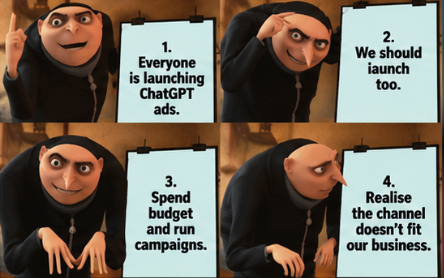
Being early to a channel gives you the opportunity to learn while the market is still developing. You can understand how customers respond, test different approaches and build experience before more advertisers enter the auction. But that advantage is only valuable if the learning is relevant to your business. Spending money on a channel that doesn't fit your product isn't innovation; it's an expensive way to satisfy your FOMO.
At Porcellia, we've always believed in moving early on channels that make sense for our brands. We started experimenting with Meta in 2017, Reddit in 2020, email marketing in 2021 and CRO in 2022. We're now testing ChatGPT ads because we believe new channels deserve to be investigated before they become crowded, not because we believe every brand should be on every platform. There's a meaningful difference between being an early adopter and blindly adopting whatever is new.
You don't need to be everywhere. You need to know where you have an unfair advantage. If ChatGPT ads fit your business, the next step is learning how to execute them properly. If they don't, that's a useful decision too. You've saved yourself the time, money and distraction of chasing a channel that was never right for you.
Deciding whether to advertise is only half the problem. Getting the product feed, tracking, landing page, campaign structure and optimisation right is what comes next. We've put together a separate guide covering the execution side of ChatGPT ads for D2C brands.
Read: How to Run ChatGPT Ads — The Practical Guide for D2C Brands
If you'd rather have someone who's already running campaigns help you evaluate the opportunity, speak to the Porcellia growth team. We'll help you figure out whether the channel makes sense for your brand before you spend money trying to make it work.
In a world optimized for speed and dopamine, meaning is the only thing that lasts.
Read the full storyIn a world optimized for speed and dopamine, meaning is the only thing that lasts.
Read the full story
Get your hands on the the stuff that actually compounds.
Positioning. Retention. Content. Community.

Welcome to Finsweet's accessible modal component for Webflow Libraries. This modal uses Webflow Interactions to open and close. It is accessible through custom attributes and custom JavaScript added in the embed block of the component. If you're interested in how this is built, check out the Attributes documentation page for this modal component.
See docs