


That pre-checked ₹49 "gift wrap" box on your checkout page? The countdown timer on a discount that was never really 50% off? The three screens a customer has to click through just to cancel an add-on they didn't ask for? Until now, this was just "good CRO." Starting 1 January 2027, it's a compliance violation, and for Shopify sellers, that's not a fine you quietly absorb, it's the kind of infraction that can get a store flagged or banned entirely.
For years, tactics like inflated anchor pricing, disguised sponsored placements, and friction-heavy cancellation flows quietly padded average order value across Indian e-commerce. India just outlawed that playbook. Here's what replaces it.
If you are still using these tactics, you are putting your brand in the legal crosshairs — and destroying the trust you need to scale.
This breakdown covers the six regulatory shifts coming to Indian e-commerce. You can read through the full piece from the beginning, or jump straight to the specific areas that impact your daily checkout flow and growth operations:
Why "50% OFF" will no longer hide the true pricing history of your product.
Why you can no longer blur the line between organic relevance and paid placement.
Why hidden opt-ins and guilt-tripping banners now carry a formal paper trail.
How nearly 30% of all consumer grievances are reshaping your customer support system.
Why fine print about returns, warranties, and import details must move directly to the product page.
Why pre-checked boxes and assumed permission are being phased out.
There is nothing inherently wrong with running a legitimate sale. In fact, if you offer a genuine deal, sale events are often when you acquire your best customers.

The problem arises when a brand inflates the anchor price overnight to create the illusion of a bargain.
Let's say your product has been steadily selling for ₹2,999/- for months. Just before a festive sale, the listed price mysteriously jumps to ₹4,999/-, and a massive red tag appears: 50% OFF. A customer buys it for ₹2,999/-, believing they just saved a significant sum. In reality, they saved nothing.
Under the updated framework, whenever a seller advertises a discount, they must also disclose the product's lowest price over the previous 30 days.
Stop relying on artificial price anchors to drive urgency. Move toward genuine value-add bundling, tiered volume discounts, or loyalty perks that give real savings without forcing you to manipulate your base pricing.
Most shoppers assume that when they type a query into a search bar, the platform returns the most relevant products available. This assumption is where search manipulation thrives.
Say a customer searches for "organic face serum." They expect the top results to reflect high ratings, relevant ingredients, and strong customer feedback. But in reality, the top three items might be there simply because a brand outbid everyone else for that screen real estate.
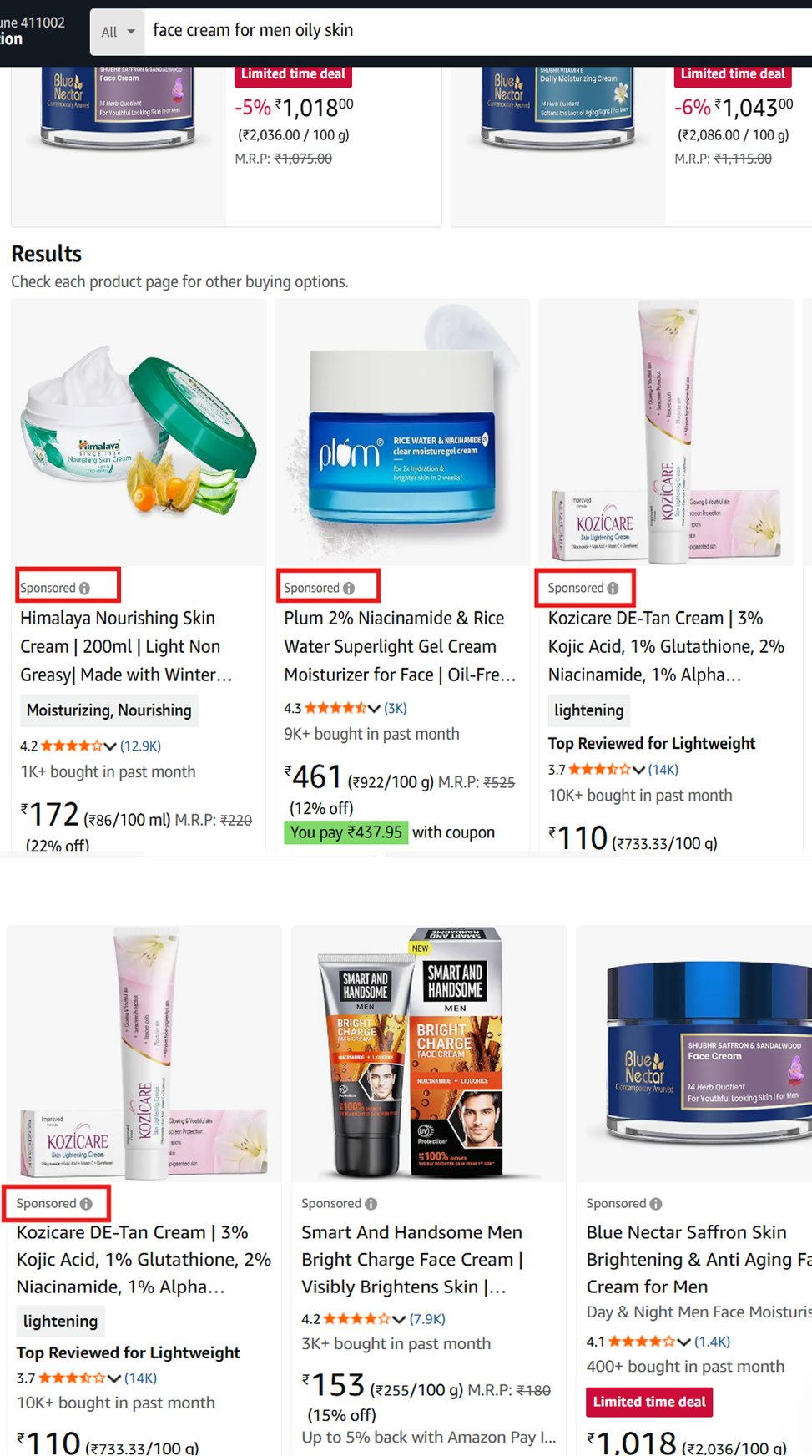
There is a fundamental difference between two distinct outcomes:
1. This product is showing up because it is genuinely relevant to what I asked for.
2. This product is showing up because a seller paid to put it in front of my eyes.
The new guidelines mandate that paid placements must be explicitly labeled as "Sponsored" or "Advertisement."
When platforms and brand stores blur this distinction, they prioritize short-term ad revenue over user intent. Requiring clear labels doesn't remove sponsored ads, but it forces businesses to expose the commercial trade-off happening on the screen.
If you run internal store search or offer sponsored placements on your catalog, clean up the visual hierarchy today. Focus your organic merchandising on true buyer intent, ratings, and repeat purchases rather than forcing irrelevant products onto your shoppers.
Eventually, most consumers start noticing the design traps built into checkout flows. They try to buy a product, and suddenly their total bill is higher than expected.
They look closely and realize:
Insurance or gift wrapping was automatically added via a pre-checked box.
Canceling an unwanted add-on required navigating three separate confirmation screens.
India introduced initial guidelines against dark patterns in 2023, but enforcement remained inconsistent. The updated mandate escalates this from a passive guideline to an active operational burden. E-commerce companies will now have to conduct an annual self-audit and publicly publish a compliance certificate.
The objective is straightforward: you can no longer claim you oppose manipulative UI design while silently profiting from the extra revenue it generates. You must systematically audit your own user flows and certify that your checkout systems do not trick the user.
Audit your checkout flow line by line. Remove pre-checked add-ons, simplify cancellation paths, and rewrite any guilt-tripping copy. A clean checkout builds long-term customer lifetime value (LTV) far better than a sneaky ₹49 add-on ever will.
The scale of unresolved customer complaints explains why regulatory intervention became inevitable.
In 2025 alone, the National Consumer Helpline (NCH) registered roughly 17.7 lakh complaints. Of those, over 5.1 lakh — nearly 29% — were tied directly to e-commerce transactions.
When nearly one out of every three consumer disputes in the country involves delayed refunds, missing items, or unresponsive customer support bots, it signals a structural breakdown in how online businesses handle dispute resolution.
By requiring direct technical integration between e-commerce platforms and the NCH portal, the goal is to prevent customer support requests from disappearing into closed-loop internal ticket systems. If an issue isn't resolved internally, the escalation path to official consumer forums becomes much shorter.

Image from Reddit
Fix your post-purchase operations before the state forces you to. Stop hiding behind dead-end chatbot loops. Build clear escalation pathways to human support and empower your team to process fair refunds quickly.
Some of the most frustrating shopping experiences happen after a customer has already hit the "Pay Now" button.
They order an item, only to discover later that it cannot be returned — only exchanged for store credit. Or they receive an imported electronic device and realize the warranty is invalid in India.
The updated rules require key operational details to be displayed prominently on the product page before checkout:
Explicit return, refund, and exchange conditions
Warranty coverage and fulfillment terms
Payment terms and hidden handling charges
Country of origin and importer details
Expiry or "best before" dates for relevant goods
Moving this information upfront changes how decisions are made. The goal is to eliminate the information asymmetry where critical terms are buried in a terms-of-service link at the bottom of your footer.
Redesign your Product Detail Pages (PDPs) for radical transparency. Place return policies, warranty terms, and origin badges right next to your purchase CTA. Upfront clarity reduces pre-purchase anxiety and actually lowers your Return-to-Origin (RTO) rates.
The final major shift targets how brands collect and monetize user data.
Historically, businesses operated on assumed consent. By creating an account or making a purchase, a buyer was often treated as having agreed to broad data-sharing terms hidden within a long privacy policy.
Under the new framework:
Consent must be explicit, active, and affirmative.
Pre-selected consent boxes are prohibited.
Opting out cannot be hidden behind dark patterns or buried settings menus.
If you want to use a customer's shopping history or personal details for secondary marketing purposes, they must deliberately check the box themselves. Silence or inaction no longer counts as permission.
Uncheck every pre-selected marketing box across your site today. Build an opt-in-first strategy where you give customers a genuine reason to share their data — like personalized recommendations or exclusive access — rather than tricking them into your promotional lists.
These amended rules are scheduled to take effect on 1 January 2027.
On paper, the direction is undeniable: clearer pricing, explicit search labels, audited user interfaces, and tighter data controls. But compliance on paper does not automatically transform consumer behaviour, and waiting until late 2026 will not fix a broken operational model.
The real question isn't whether the government can write stricter rules. It's whether you will proactively build a transparent, high-trust brand today — or continue relying on conversion tricks until regulatory compliance and rising customer fatigue force your hand.

In a world optimized for speed and dopamine, meaning is the only thing that lasts.
Read the full storyIn a world optimized for speed and dopamine, meaning is the only thing that lasts.
Read the full story
Get your hands on the the stuff that actually compounds.
Positioning. Retention. Content. Community.

Welcome to Finsweet's accessible modal component for Webflow Libraries. This modal uses Webflow Interactions to open and close. It is accessible through custom attributes and custom JavaScript added in the embed block of the component. If you're interested in how this is built, check out the Attributes documentation page for this modal component.
See docs