

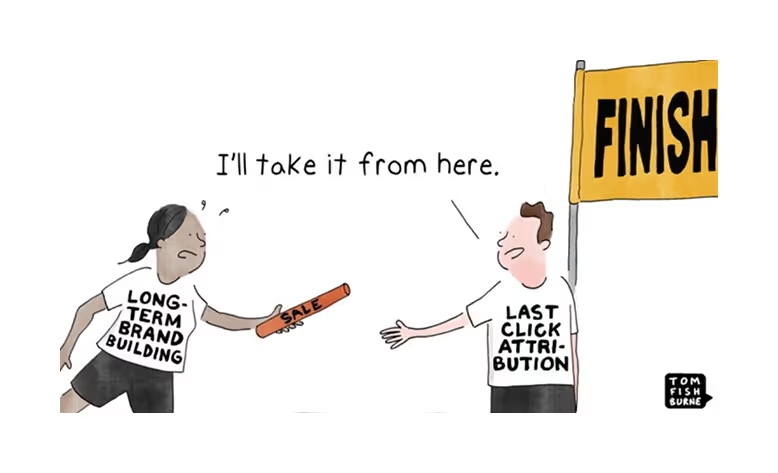
Every time we onboard a new client at Porcellia, the conversation eventually reaches this point.
Someone opens Ads Manager.
Points at a creative.
And asks:
“This ad has bad ROAS. Why is it still running?”
A few days later, it escalates.
“Meta isn’t working.”
“Influencers aren’t working.”
“Email isn’t doing much.”
At that moment, it becomes clear.
This is not a performance problem.
This is an attribution problem.
If you’re evaluating marketing per ad or per channel, you’re already thinking about it wrong.
Because marketing does not work in parts.
It works as a system.
And the moment you try to isolate one part and judge it independently, you break the very thing that makes it work.
You want to lose weight.
What works?
Is it:
Or is it:
You go to the gym for 10 days.
No visible fat loss.
You say:
“Gym has bad ROAS. Let’s stop it.”
Meanwhile:
And that is what eventually led to weight loss.
So what caused the result?
The gym?
The sleep?
The diet?
Or the system working together?
Inside companies, marketing is neatly divided:
But customers don’t think like that.
They don’t say:
“I bought because of Meta ads.”
They say:
“I’ve been seeing this brand everywhere.”
They might have:
And then, maybe weeks later, they buy.
So tell me:
Which channel gets the credit?
Let’s get slightly more technical.
If you look at attribution dashboards or UTMs:
So by that logic, social media doesn’t matter.
Right?
Now look at reality.
Brands that have:
These brands typically see:
120–150% higher overall ROAS than brands that don’t.
So what’s happening?
Social media is not converting.
It’s creating demand.
And that demand is being captured somewhere else:
Which then take all the credit.
Same story with email.
If you look at UTM attribution:
So most founders assume:
“Email isn’t that important.”
But when you zoom out:
Brands that do email properly:
See:
25–35% higher retention
Which directly impacts:
So email is not just a revenue channel.
It’s a retention engine.
But attribution doesn’t show that.

Because not only is attribution incomplete…
It is also manipulated.
Platforms like Meta and Google over-attribute by design.
If Meta actually drives ₹100 in revenue,
it will often claim ₹300–₹400.
Why?
Because:
And every platform is trying to prove:
“I drove this sale.”
So when you look at:
And add them together…
You’ll often see: ₹40 lakhs reported
But your actual Shopify revenue is: ₹25 lakhs
Where did the extra ₹15 lakhs come from?
Double counting. Attribution inflation.
You’re stuck between two broken systems:
And in the middle of this chaos…
You’re trying to decide:
“Which ad should I turn off?”
When you optimise based on this data:
You:
Because that’s what shows results.
And slowly:
You become a performance-only business.
And performance-only businesses don’t scale profitably.
Nike made one of the most expensive marketing mistakes in history.
They shifted from brand-led storytelling to performance-led, data-driven marketing. Instead of creating demand, they started optimizing for what was easiest to measure - retargeting, digital conversions, and short-term sales. (new CEO was appointed in 2020 and came with his own philosophy)
On dashboards, everything looked efficient.
In reality, the brand lost its aspiration.
They stopped creating new demand and focused only on capturing existing demand.
The result?
A $25 billion drop in market value.
Because they chose what was measurable over what was effective.
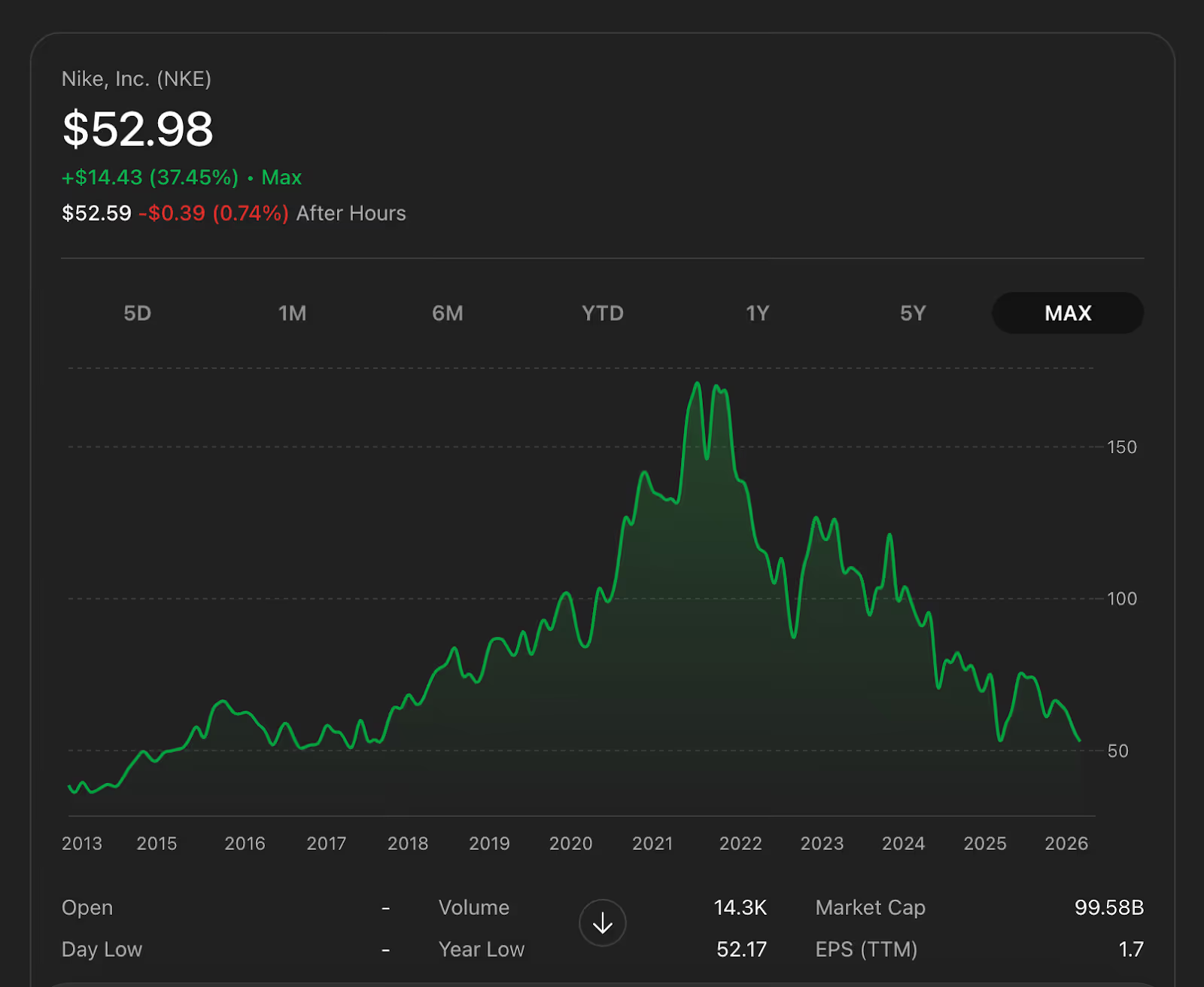
Nike’s share price last few years. Short term spike post 2020 following an aggressive performance first approach, followed by a freeeee fall.
One of the core ideas in Organic Growth Mastery is this:
You don’t grow by optimizing channels. You grow by strengthening the system.
That system includes:
Each piece reinforces the other.
No single part can be evaluated in isolation.
We don’t look at:
as decision-making metrics.
We look at:
Because these reflect the output of the system.
Not the illusion of individual parts.
We still analyse:
But not to:
“turn things on or off blindly”
We use them to:
Not to break it.
If you’re managing ads, you’re operating.
If you’re building demand, you’re building a brand.
And the difference is simple:
One focuses on parts.
The other focuses on the system.
Because in the real world…
Nothing works alone.
And the brands that understand this are the ones that win.
In a world optimized for speed and dopamine, meaning is the only thing that lasts.
Read the full storyIn a world optimized for speed and dopamine, meaning is the only thing that lasts.
Read the full story
Get your hands on the the stuff that actually compounds.
Positioning. Retention. Content. Community.

Welcome to Finsweet's accessible modal component for Webflow Libraries. This modal uses Webflow Interactions to open and close. It is accessible through custom attributes and custom JavaScript added in the embed block of the component. If you're interested in how this is built, check out the Attributes documentation page for this modal component.
See docs