
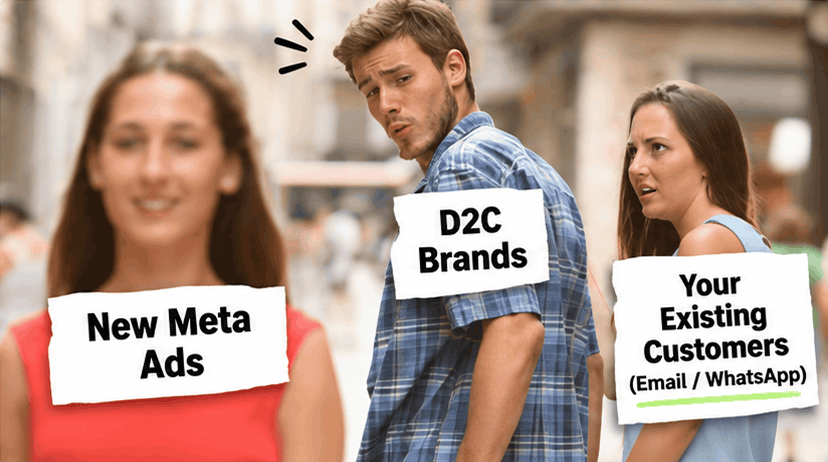
Most brands will pay Meta to sell to customers who would have happily bought with almost 0 CAC. But you’re not doing the one thing that can unlock this 0 CAC acquisition for you. Here is how to make your sale more profitable without selling one extra product.
If you’re a D2C founder, chances are you’re not running a sale right now but you’re almost certainly planning one for November. Some of you will run conservative sales with modest offers. Others will go all out with aggressive pricing, massive ad budgets, and ambitious revenue targets. Regardless of which category you fall into, there’s one mistake I see D2C brands make every single sale season. And it costs them lakhs of rupees.
They spend money on Meta to sell to customers who would have happily purchased through email or WhatsApp at a fraction of the cost.
I’m going to explain how to avoid this, why your existing customers should get a better deal than new customers, and how to make your November sale significantly more profitable without necessarily selling a single additional product.
Before you launch your sale, I want you to look at your revenue projections.
Ideally, 20–30% of your total sale revenue should come from email and WhatsApp. If you’re a premium brand, email should be doing a lot of the heavy lifting. If you’re a mass-market brand, WhatsApp can be incredibly effective.
Now, let’s say you’re planning to sell 1,000 units of a particular product during your November sale. Here’s what I want you to do differently.
Before your sale goes live to the general public, give your existing customers exclusive early access. Not your Instagram followers. Not people who have visited your website. Your actual existing customers.
Tell them that your November sale is coming, that inventory is limited, and that you’re giving them first dibs before opening it up to everyone else. Your target should be to sell the first 100–200 units of every 1,000-unit inventory target through email and WhatsApp alone.
No Meta ads. No paid retargeting. Just your existing customer database.
There’s a very simple reason this works. Your existing customers already know your brand. They’ve already trusted you enough to purchase from you. They don’t need to be convinced about your credibility all over again.
And when you tell them they’re getting access before everyone else, AND that the stock is limited, you’re giving them something that feels genuinely valuable.
They’re getting priority. They’re getting access to limited inventory. And they have a reason to act immediately rather than waiting until the last day of the sale.
The objective is simple: convert as much of your existing customer demand as possible before you start paying Meta to capture that same demand.
Here’s where things get interesting. Meta allows you to look at your sales across three audience segments: new users, engaged users, and existing customers.
During your November sale, I want you to pay very close attention to this breakdown. If you’ve done your email and WhatsApp marketing correctly, a significant portion of your existing customers who were likely to purchase during the sale should have already bought during early access.
That means when your paid campaigns go live, your focus should shift toward acquiring new customers and converting engaged audiences who haven’t purchased yet.
Your existing-customer contribution from Meta should ideally be very small.
I’m not saying you should never retarget. I’m saying you should stop blindly allocating money to retargeting without asking whether those customers could have been converted through a much cheaper channel.
Let’s take a brand spending ₹10 lakh on Meta during its November sale. It’s entirely possible that ₹1–1.5 lakh of that budget ends up being spent on retargeting existing customers.
And because these customers already know the brand, those campaigns might show a beautiful 6x or 7x ROAS. The performance marketing team celebrates. The dashboard looks fantastic. But here’s the question nobody asks.
Why did you spend ₹600 acquiring a customer you could have converted for ₹30–40 through email?
That 7x ROAS doesn’t necessarily mean your advertising created seven times the revenue. Some of those customers might have purchased anyway.
Attribution and incrementality are two very different things.
And this is precisely why I keep telling founders that ROAS alone is a terrible way to judge the profitability of their marketing.
Let me explain this with some very simple unit economics. Assume you’re selling a product with the following economics:
Here’s what happens when you sell this product through Meta.
Now, instead of retargeting that same existing customer on Meta, imagine you send them an email offering an exclusive 25% discount.
Yes, a bigger discount.
Read that again.
You gave your customer an additional ₹150 discount and still made ₹410 more contribution on the same product. Your customer is happier because they’re getting a better deal. You’re happier because you’re making more money. And you’re no longer paying Meta to bring back someone who has already purchased from you.
This is the beauty of owning your customer relationship. Of course, actual contribution margins will also depend on shipping, payment fees, returns, taxes, and other variable costs. And the email cost here is illustrative, not a universal benchmark.
But the underlying principle doesn’t change. When your cost of converting an existing customer falls dramatically, you have more room to improve your offer without destroying your margins.
The cheapest acquisition cost isn’t always the lowest CAC you can achieve on Meta. Sometimes it’s the customer you don’t need Meta to acquire at all.
Let me give you some context from our own portfolio at Porcellia.
Over the last 60 days, the brands we work with have collectively generated approximately ₹70–80 crore in total Shopify revenue across all channels. Of that, ₹5–7 crore has been attributed directly to email campaigns.
And I want to make one thing extremely clear.
I’m not talking about automated flows. I’m not talking about abandoned cart recovery, welcome sequences, browse abandonment, post-purchase journeys, or any of the automated emails that continue running in the background. I’m talking about campaigns.
Emails that someone on the team planned, wrote, designed, segmented, scheduled, and sent. That’s ₹5–7 crore in campaign-attributed revenue, excluding automated flows entirely. Now, campaign attribution is not the same as incremental revenue. Not every rupee attributed to an email necessarily exists because of that email. But when you see this level of revenue consistently coming through a channel that costs a fraction of paid media to operate, you should be paying attention.
And yet, I speak to D2C founders every week who barely send five emails a month. Which brings me to something I’ve been wanting to say for a very long time.
Some of the biggest D2C brands are sending 30–40 emails every month. Meanwhile, you’re worried that sending a sixth email will annoy your customers.
Why? Your customers don’t care whether you’re a ₹10 crore brand or a ₹500 crore brand. They care whether what you’re sending them is relevant, interesting, and worth their time. If every email you send is another generic 10% off offer, of course people are going to get bored. But that’s not an email frequency problem. That’s a creative strategy problem.
Think about how you approach Meta advertising. You don’t make four creatives at the beginning of the month and hope they generate revenue for the next 30 days. You test different hooks, different angles, different formats, different customer pain points, and different offers.
Why aren’t you doing the same thing with email?
Test educational emails. Test founder stories. Test product comparisons. Test customer testimonials. Test category education. Test plain-text emails. Test beautifully designed emails. Test urgency. Test exclusivity. Test different subject lines, offers, and audience segments.
And don’t just measure open rates. Measure clicks, conversions, revenue per recipient, contribution margin, unsubscribes, and the incremental revenue your campaigns actually generate.
I’m not saying every brand should blindly send 40 emails a month. Frequency needs to make sense for your audience, database quality, and engagement. But if you have a healthy customer database and you’re sending four or five campaigns a month, I can almost guarantee you haven’t explored the full potential of this channel.
You’re testing hundreds of creatives to acquire new customers while barely testing anything to generate more revenue from customers you’ve already acquired. That makes absolutely no sense to me.
If you’re planning a sale this month, you still have an opportunity to change how you approach it. Don’t start by asking how much more money you should spend on Meta. Start by asking how much revenue you can generate before spending a single rupee on advertising.
Look at your existing customer database. Segment your customers by purchase history, recency, frequency, and product affinity. Figure out who is most likely to purchase again. Build your early-access campaign. Give those customers a genuine reason to buy before everyone else. Test your offers. Send reminders. And make sure your email and WhatsApp campaigns are coordinated rather than bombarding the same people with identical messages. Then launch your broader sale.
Use Meta to reach people you haven’t converted yet, rather than paying unnecessarily to bring back people you already had a direct relationship with.
And please, don’t judge success purely by how much revenue your sale generates. Judge it by how much money you actually keep.
A ₹1 crore sale with terrible contribution margins isn’t necessarily better than an ₹80 lakh sale with healthy margins.
Revenue is what you generate. Contribution is what gives you the ability to keep growing.
If you already have a large customer database and your email and WhatsApp infrastructure is in place, but you’re struggling to reactivate customers or capture the demand that’s already there, feel free to reach out to us at Porcellia. This is something we work on extensively across our brands.
 Only What’s Needed™
 foxtale
But whether you work with us or not, I want you to remember one thing this November.
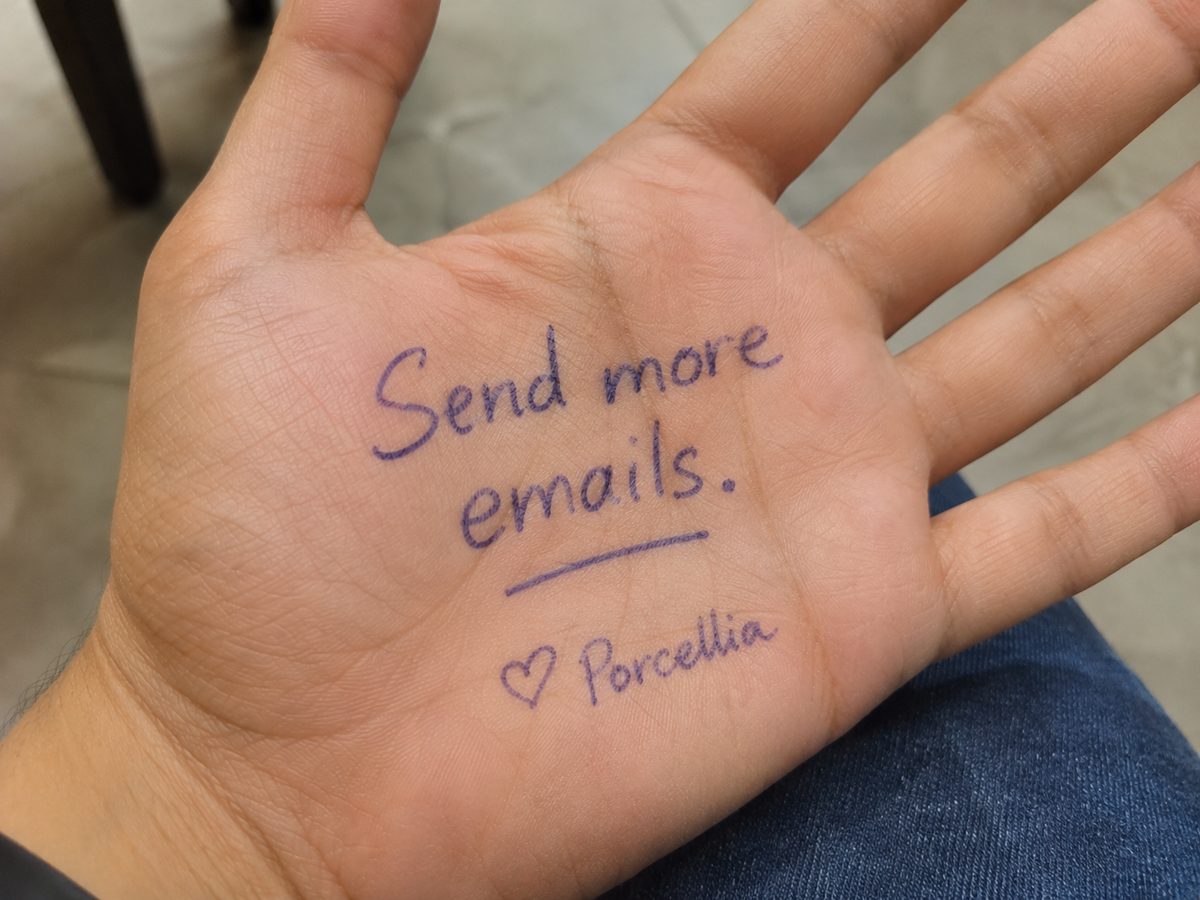
Before you spend another ₹1 lakh on retargeting, send a few more emails.
You might be surprised by how much money you’ve been leaving on the table.
In a world optimized for speed and dopamine, meaning is the only thing that lasts.
Read the full storyIn a world optimized for speed and dopamine, meaning is the only thing that lasts.
Read the full story
Get your hands on the the stuff that actually compounds.
Positioning. Retention. Content. Community.

Welcome to Finsweet's accessible modal component for Webflow Libraries. This modal uses Webflow Interactions to open and close. It is accessible through custom attributes and custom JavaScript added in the embed block of the component. If you're interested in how this is built, check out the Attributes documentation page for this modal component.
See docs