

.png)
A lot of the most successful D2C brands of the last few years were built by creative founders. People who understood their consumers really well, knew how to make great ads and had an instinctive understanding of what would make somebody stop scrolling and pay attention to their brand.
And for a long time, that was enough. If you could understand the consumer better than the competition and turn that understanding into good creative, you could build a business remarkably quickly. You didn't necessarily need a massive team, complicated systems or even a particularly mature organisation. The founder could do a large part of the work themselves, move quickly and make decisions faster than everyone else.
This created an entire generation of creator-led and creative-first D2C businesses. A lot of them went from zero to ₹20L a month, then ₹50L, ₹60L and sometimes ₹80L a month much faster than the founder had expected. But a lot of these businesses then got stuck.
Not necessarily because growth stopped working. Not because the founder suddenly became bad at what they were doing. And not always because there was something fundamentally wrong with the business. The business had simply reached a point where the way it was built could no longer support the next stage of growth.
That, I think, is the D2C trap for creative founders. The skill that helped you get from 0 to 1 can become the reason you struggle to get from 1 to 10.
This article has been divided into four parts. You can read the entire thing from the beginning, but if you've already come here after reading the first two parts of the Instagram series, you can skip directly to the new sections.
Why creative founders can build exceptional 0→1 growth engines, and why those same engines eventually stop scaling.
Why replacing a founder's capability with an underqualified or underpriced hire almost always creates a vicious cycle.
Why continuing to operate the same function as the business grows can quietly damage everything else in the company.
How to document your thinking, build the right team and transition from founder-led growth to a scalable function.
Already read Parts 1 and 2?
There is nothing wrong with founder-led creative in the early stages of a company. In fact, if you're a genuinely strong creative founder, it is probably one of your biggest competitive advantages.
You understand the customer because you have spent years thinking about them. You know what language they use, what problems they actually have and which of those problems are important enough for them to spend money solving. You can look at an ad, a landing page or a piece of communication and instinctively understand when something is not working. Most importantly, you can move fast.
At an early stage, that is incredibly valuable. There are no layers of approvals, no complicated processes and very little distance between an idea and execution. You can have an observation in the morning, turn it into a creative brief by afternoon and have the campaign live the next day. That speed is a genuine advantage. The problem is that the business eventually gets bigger while the founder continues to operate in exactly the same way.
Your monthly revenue goes from ₹10L to ₹50L. Your advertising spend increases. The number of creatives you need increases. The team gets larger. There are more products, more campaigns, more channels and more customers to think about. But the founder is still reviewing every important ad.
Still fixing every brief.
Still deciding what to test.
Still making decisions that, at some point, other people in the organisation need to start making. And this is usually where creative founders get stuck.
Because creative-led growth works exceptionally well when the company is small. The founder's judgement can touch almost everything, and that judgement is often significantly better than the people around them. But once the business reaches a certain size, there is simply too much happening for one person's judgement to remain the operating system for the entire growth function.
The founder doesn't necessarily become less capable. The company just becomes more complex than one person's ability to operate everything. And that is when your greatest strength starts becoming a bottleneck. Every hour you spend personally doing the work you are best at is an hour you are not spending on the other things the business now needs from you. Hiring, operations, leadership, systems, capital allocation and the overall direction of the company all start becoming more important.
The problem isn't that you should suddenly stop caring about creative. You probably shouldn't.
The problem is that the company cannot continue to depend on you operationally for every important creative decision.
At 0 to 1, your ability to execute is what creates value. At 1 to 10, your ability to create leverage becomes much more important. And if you don't make that transition, you eventually become both the most valuable person in the company and the biggest reason it cannot scale.
Eventually, most founders realise this. They look at how much of the growth function depends on them and decide that they need to step back. This is usually the right decision, but the way they approach hiring is where things start going wrong.
Let's say you've built a ₹60–80L MRR business. You have spent years developing your understanding of consumers, creative, performance marketing, messaging and growth. Your judgement has probably been responsible for a significant part of the business getting to where it is.
Now you want somebody to replace you. The capability you are trying to replace is probably worth significantly more than you think. If your personal ability to run creative and growth has helped build a business doing ₹60–80L a month, you're not trying to replace a junior executive. You're trying to replace years of experience, instinct and pattern recognition that currently exist almost entirely inside your head.
But what do most founders do?
They go out looking for someone at ₹60,000 or ₹1 lakh a month and expect them to do what they have spent years learning to do. Then performance drops.
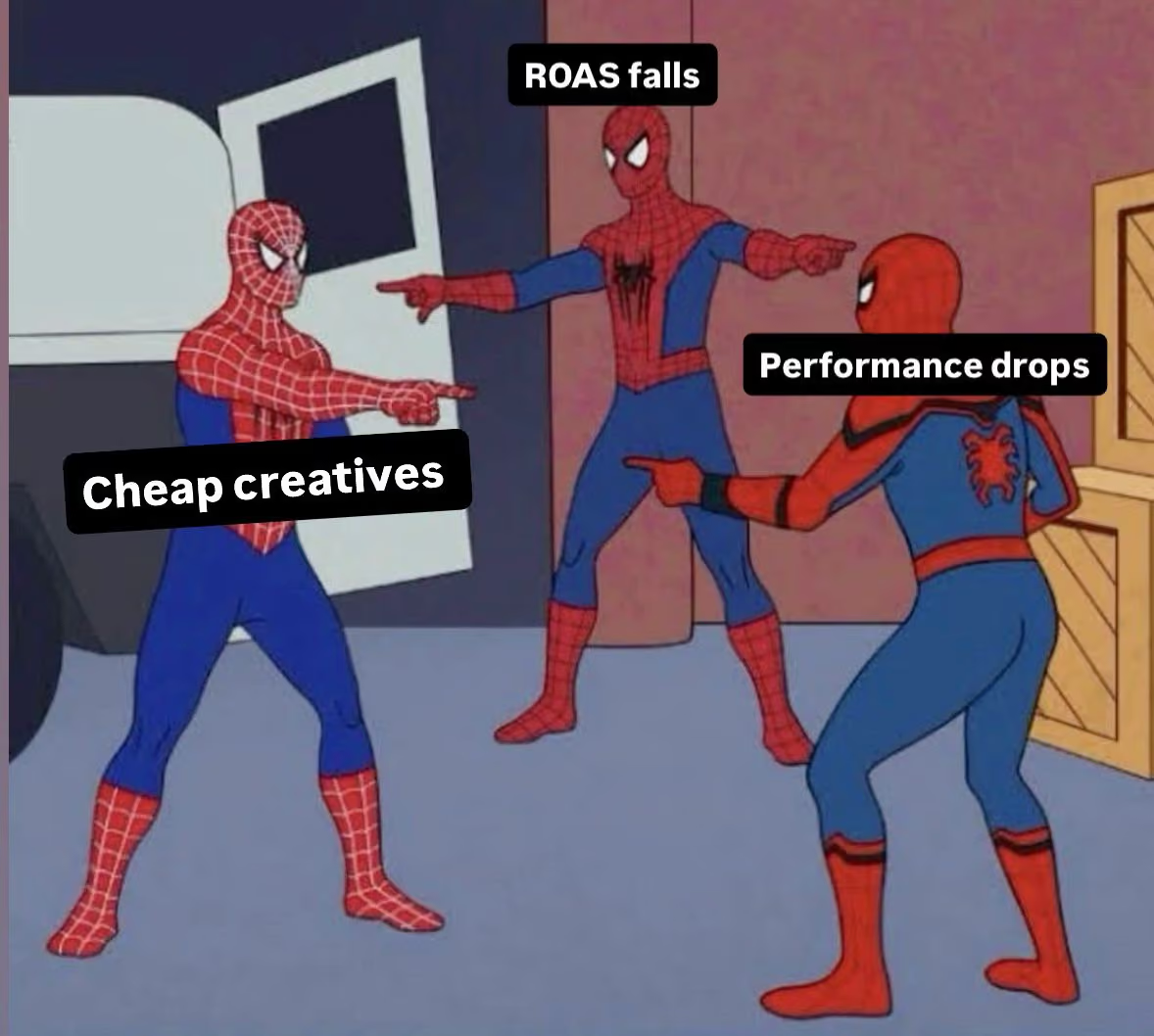
The ROAS falls, the creative isn't as strong and the speed of testing starts slowing down. Revenue might take a hit, and suddenly the founder jumps back into the function because, unsurprisingly, they can do the job better than the person who has just joined. This reinforces the founder's belief that nobody else can do the work.
And for the moment, they may actually be right. But this creates a vicious cycle. You step away, numbers fall and you come back. You hire somebody else, things don't work out and you take over again. Eventually, six or eight months have passed, and you're still doing exactly the same work you were trying to escape. This isn't always a hiring problem. It's often a talent calibration problem.
You cannot expect to replace a ₹3–4 lakh capability with a ₹1 lakh hire just because you're paying yourself less than that as a founder. The economics of a founder and the economics of replacing a founder's capability are two completely different things.
The question should not be, "Can I find somebody exactly like me?"
You probably can't.
The question should be, "How do I build a team that can eventually become better than me?"
And answering that question requires a completely different approach to hiring.
This is probably the most dangerous part of the trap because, from the outside, everything can still look successful. Revenue is growing. The team is growing. Ad spend is growing. You are hiring more people and managing more things than you were a year ago. The company is clearly bigger. But you need to ask yourself one important question: has your operating model actually changed? Or are you still doing the same job?
A lot of founders continue reviewing every important ad, fixing every brief and getting involved in every major growth decision even after the business has become significantly larger. At ₹10L a month, this might be perfectly reasonable. At ₹20L a month, it may still be necessary. At ₹80L a month, however, you have a different problem. You're no longer responsible for just getting growth right. You're responsible for a company. Someone needs to think about hiring, operations, finance, logistics, customer experience, culture, leadership and strategy. As the business gets larger, these functions don't become less important simply because growth continues to work. They become more important. And if you are still personally operating the same function that you built at ₹10L or ₹20L a month, you have to ask who is building everything else. This is how founders accidentally create a better job for themselves instead of building a better company.
The business gets bigger, but so does the founder's job. There are more employees, more meetings, more campaigns, more decisions and more problems to solve. The founder feels busier than ever and, in many cases, believes they are scaling because there is simply so much more happening. But being busier isn't the same thing as building leverage. You may simply be doing the same job at a larger scale. And eventually, the rest of the business starts paying the price.
Hiring gets delayed because nobody is spending enough time thinking about the right organisation. Operations begin to break because the founder is not involved early enough. Customer support becomes a problem after it has already become painful. Logistics gets attention only when customers start complaining. Even relationships between co-founders can start suffering because nobody has enough time to think beyond the urgent problems in front of them. Meanwhile, the founder is still fixing another ad.
The irony is that the thing you are best at can consume so much of your attention that you fail to build the rest of the company around it. A bigger business does not necessarily mean a better company. Sometimes it just means you have created a much bigger and more stressful job for yourself.
There is another reason founders find this transition so difficult. Your growth projections don't account for it. Let's say you're currently doing ₹20L a month and growing at 30% month-on-month. You open a spreadsheet, carry that number forward for the next 12 or 24 months and suddenly have a very exciting projection. That projection starts influencing everything.
Your hiring plan.
Your cash flow.
Your expectations.
Sometimes your fund raising story.
But businesses don't grow like spreadsheets. Somewhere between 0 to 1, 1 to 10 and eventually 10 to 100, the founder has to change. The organisation has to change with them, and the way the company operates has to evolve. That transition takes time. It can temporarily slow down growth. It can hurt performance. And none of this appears when you simply drag a 30% growth formula across the next 24 columns of an Excel sheet. This is where founders can become unnecessarily hard on themselves.
You have projected a particular growth trajectory, so you keep chasing it. When you don't hit it, you assume something must be broken. Maybe the market has changed, maybe your team isn't good enough or maybe you have suddenly become bad at building your own company. But sometimes nothing is broken. You're simply going through a transition that should have been built into the growth plan from the beginning.
The company is changing from one stage to another, and you are trying to build a new operating model while still expecting the old one to deliver exactly the same numbers. That is not always possible.
So what do you do if you're already here?
You've built a business doing ₹50–80L a month. The entire growth engine still depends heavily on you, and every time you try to step away, performance drops. You've tried hiring people. You've tried agencies. You've taken back control, stepped away again and repeated the cycle.
The first thing you need to accept is that there is no completely clean transition out of founder-led growth. Your ROAS might fall. Growth might slow down. The new team may initially perform worse than you. That does not automatically mean you have made the wrong decision. It may simply mean that you are finally doing the difficult work of building an organisation instead of continuing to operate one.
This will probably take one or two months, and it requires much more than documenting processes. Processes are relatively easy to document. Your thinking is not. You need to write down your thesis.
How do you think about creative?
What makes you reject an idea?
What makes you scale something?
What patterns have you noticed after looking at hundreds or thousands of ads?
How do you decide what to test next?
A lot of founders struggle with this because they have never had to explain how they make decisions. They just make them. But if you want someone else to eventually take over the function, you need to turn your instinct into something another person can understand. You may never be able to fully transfer your instinct, but you can build frameworks around the thinking that created it.
Instinct cannot really be delegated. Frameworks can. The goal is not to create a perfect instruction manual that allows somebody to become a clone of you. The goal is to make the way you think visible enough for other people to learn from it, challenge it and eventually improve it.
This is where most founders hesitate. The people who have actually operated at the level you're trying to reach are expensive. If you are looking for someone who has built and managed a growth or creative function at a similar scale, you may need to spend ₹1.5 lakh, ₹2 lakh or even ₹2.5 lakh a month.
And in many cases, that's exactly what you should do. You cannot solve a ₹5 crore problem with a ₹1 lakh hire. The person you're hiring doesn't need to be exactly like you. In fact, they probably shouldn't be. But they should bring something that you currently don't have: experience of operating a larger function, building teams and creating systems around the work. Sometimes the fastest way to build institutional capability is to hire people from companies that have already solved the problem you're trying to solve.
If you know a company that has built an exceptional creative or growth function and you're now trying to build something similar, go after the people who built it. You don't need to reinvent every capability internally when people who have already developed that knowledge exist in the market. Your job is to combine two things. Your internal thesis about your customer, your brand and your business. And their external experience of building the kind of organisation you now need. That combination can be far more powerful than either of you working alone.
This is probably the hardest part for a founder. You've spent years being the person who can fix things. So when performance falls, your natural instinct is to jump back in.
Don't. At least, don't immediately. If you've spent the time documenting your thinking, hired genuinely good people and given them the right context, you have to give the transition enough time to work.
Don't panic after two bad weeks.
Don't take the entire function back after one bad month.
Don't decide that the hire was a mistake simply because the numbers don't immediately look as good as when you were personally operating everything.
Give it three or four months. Maybe longer. Yes, the transition might cost you some short-term growth. But you need to compare that cost against the alternative. The alternative is spending the next six or eight months hiring, firing, trying agencies, taking control again and repeatedly attempting the same transition without ever allowing it enough time to actually happen. You remain stuck.
I want to make one thing clear here. The answer is not for every creative founder to completely remove themselves from creative strategy. That may be the wrong decision.
If you have multiple strong co-founders and can divide responsibilities effectively, you may be able to remain deeply involved in the strategic direction of creative while other founders build the rest of the company. There are founders who should remain close to the function that made them exceptional. The problem is not involvement. The problem is operational dependence.
There is a significant difference between saying, "I am responsible for the creative direction of this company," and saying, "This company cannot produce good creative unless I personally review every important piece of work."
The first is leadership.
The second is dependency.
One can scale.
The other cannot.
Your objective isn't necessarily to become less creative or even less involved in growth. The objective is to stop building a business that cannot operate without you.
When founders project growth, they usually project revenue. They should also project transitions.
At what point does a particular function stop being founder-led?
When do you need your first senior hire?
When does that person need a team under them?
How long will the transition take?
How much runway do you need to give a new team enough time to learn?
What happens if performance temporarily drops while the transition is happening?
These are not questions you should start asking when you're already exhausted. The ideal time to build the next layer of the company is before you desperately need it. Because once the founder is already stretched beyond capacity, every attempt to step away becomes more difficult. There is no time to document the work properly. There is no patience to let a new hire learn. And every bad week creates pressure to jump back in. That is why so many founders get stuck at the same stage for far longer than they should.
Creative founders don't usually get stuck because they aren't good enough at growth. They get stuck because they are too good at it. Every time something goes wrong, they know how to fix it. When the creative isn't working, they can improve it. When performance drops, they can identify the problem faster than everyone else around them.
And every time they step back in and save the day, they reinforce the same dependency. The company learns that when something goes wrong, the founder will fix it. But you cannot build a scalable company if the solution to every important problem is the founder. At some point, your job has to change. Not because you are becoming less valuable. But because the value you create needs to become more leveraged. Your next stage of growth probably won't come from doing your old job better. It will come from building people who can do that job, creating systems that make those people better and eventually building leaders who can build more people. That is the real transition from founder-led growth to function-led growth. And it is not easy.
Your numbers may temporarily fall. Your ROAS may get worse. You will probably want to step back in, and there will be moments when you genuinely question whether you made the right decision. But if you refuse to go through that transition, you may eventually hit a ceiling and spend years trying to understand why. The answer might be much simpler than you think.
Your business didn't necessarily outgrow the market.
It didn't necessarily outgrow the product.
It may simply have outgrown the way you operate.
And that is the D2C trap for creative founders. The skill that made you exceptional at 0 to 1 can become the operating model you have to outgrow to get from 1 to 10.
If you are a founder who was once the primary creative brain behind your business, this problem will probably feel very familiar. Maybe your business grew because you were exceptionally good at creative, consumer understanding or growth. But now the company is bigger, there is more happening than you can personally manage and growth has started slowing down because you simply cannot find the time to do everything you used to do.
Maybe you've tried hiring people and it hasn't worked.
Maybe you've tried agencies.
Maybe you keep stepping away, watching the numbers fall and taking control again.
Or maybe you already know that this transition needs to happen, but you have absolutely no idea where to start.
This is something we work on at Porcellia.
We are a creative specialist team that has worked closely with founders and D2C businesses through different stages of growth. We understand that the problem isn't always about finding another agency or producing more creatives. Sometimes the real problem is that the growth engine is still sitting inside the founder's head.
We can help you document that thinking.
We can help you turn it into a creative and growth operating system that other people can actually work with.
We can help you operationalise it.
We can help you identify what kind of creative talent you actually need, help you structure the team around that capability and even help you hire the right people.
But most importantly, we can help you make the transition from a business that depends on the founder's personal creative ability to one that can continue growing without requiring the founder to operate every part of the function themselves. Because that's ultimately the transition.
You're not trying to become less valuable to your business.
You're trying to make your value more scalable.
And if you're currently stuck somewhere in that transition, we'd genuinely love to help.
In a world optimized for speed and dopamine, meaning is the only thing that lasts.
Read the full storyIn a world optimized for speed and dopamine, meaning is the only thing that lasts.
Read the full story
Get your hands on the the stuff that actually compounds.
Positioning. Retention. Content. Community.

Welcome to Finsweet's accessible modal component for Webflow Libraries. This modal uses Webflow Interactions to open and close. It is accessible through custom attributes and custom JavaScript added in the embed block of the component. If you're interested in how this is built, check out the Attributes documentation page for this modal component.
See docs