

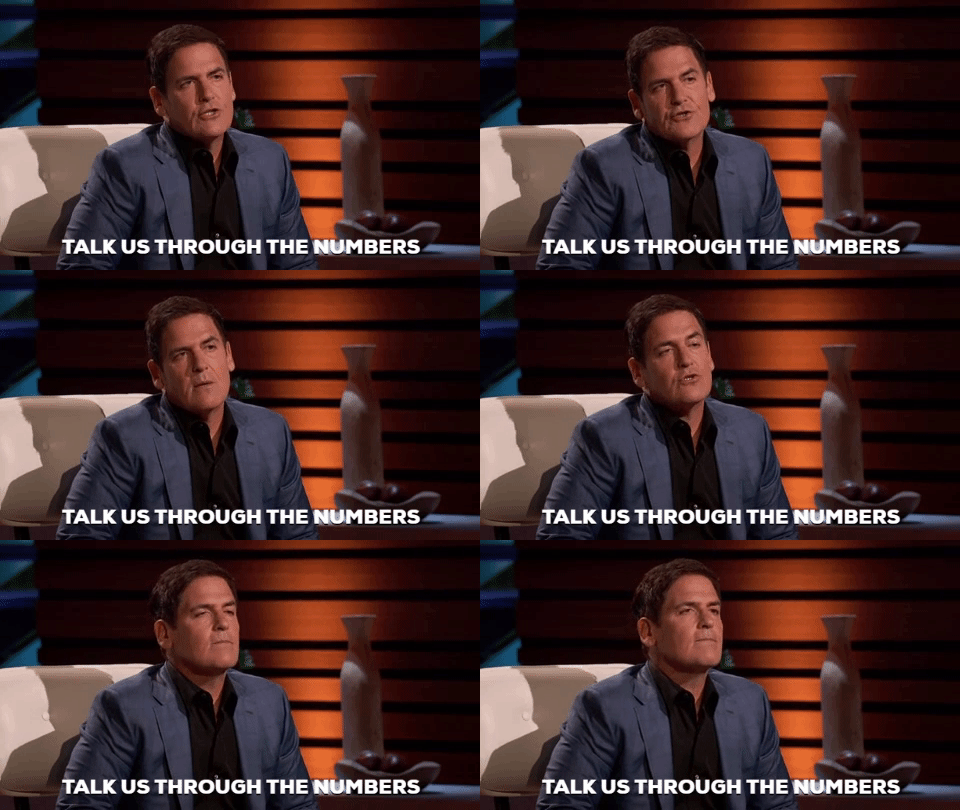
It should be.
A lot of founders spend years trying to get there. When it finally happens, it feels like you’ve crossed some invisible line. But something interesting happens around this number.
Growth becomes more structured. You start caring about systems. You start caring about operational excellence.
And that’s exactly what scaling brands need.
So this is not a criticism of scale.
Scaling brands is serious work and honestly, it’s some of the most interesting work we do at Porcellia.
But there’s a subtle shift that starts happening in parallel.
And it took me a while to notice it. (I had been feeling this tingling sensation inside me for the last 6 months and FINALLY this week i got the breakthrough!!)
Before we go deeper, let me tell you what this article is about.
If you just want to skip the story and see what we built, jump straight to “The 0 → 1 Solution” below.
But the story matters.
Because the realisation came from somewhere unexpected.
As brands grow from 1 → 10, something natural happens.
They become more careful. More process-driven. More structured. Which makes sense.
When you’re doing ₹1Cr/+ month, every decision carries real consequences.
You’re no longer experimenting with existence. Infact, you’re doing everything you can do to protect that existence.
Naturally, innovation slows down.
Not because anyone wants it to.
But because the cost of experimentation becomes higher.

Both responses make sense.
But they create very different environments.
(I also blame MBAesque brand managers for this phenomenon but i will rant about them some other time)
Most people assume innovation happens inside big companies.
In reality, it almost always comes from small ones. Early-stage founders can move fast. They can try weird ideas. They can experiment because there’s very little to protect.
No approval cycles.
No brand bureaucracy.
No fear of breaking something big.
And that chaotic environment is where most growth breakthroughs are discovered.
This became obvious to me recently in a very random way.
My wife started a business a few months ago - An athletic pilates studio in Koramangala called S34.
And because we live together now, I naturally get pulled into random parts of the process -> Shooting videos, running ads, testing ideas, funnels etc. And the way things happen there is completely different from how things happen inside large companies.
Someone has an idea.
We shoot it. We edit it. We post it.
Sometimes all in the same day.
No decks. No approval chains. Just pure startup energy.
And while doing that, something clicked.
This is the environment where the most interesting ideas actually happen.
The brands that made Porcellia exciting in the early days were all 0 → 1 brands.
Shasn
The Cinnamon Kitchen
The Plated Project
Nack
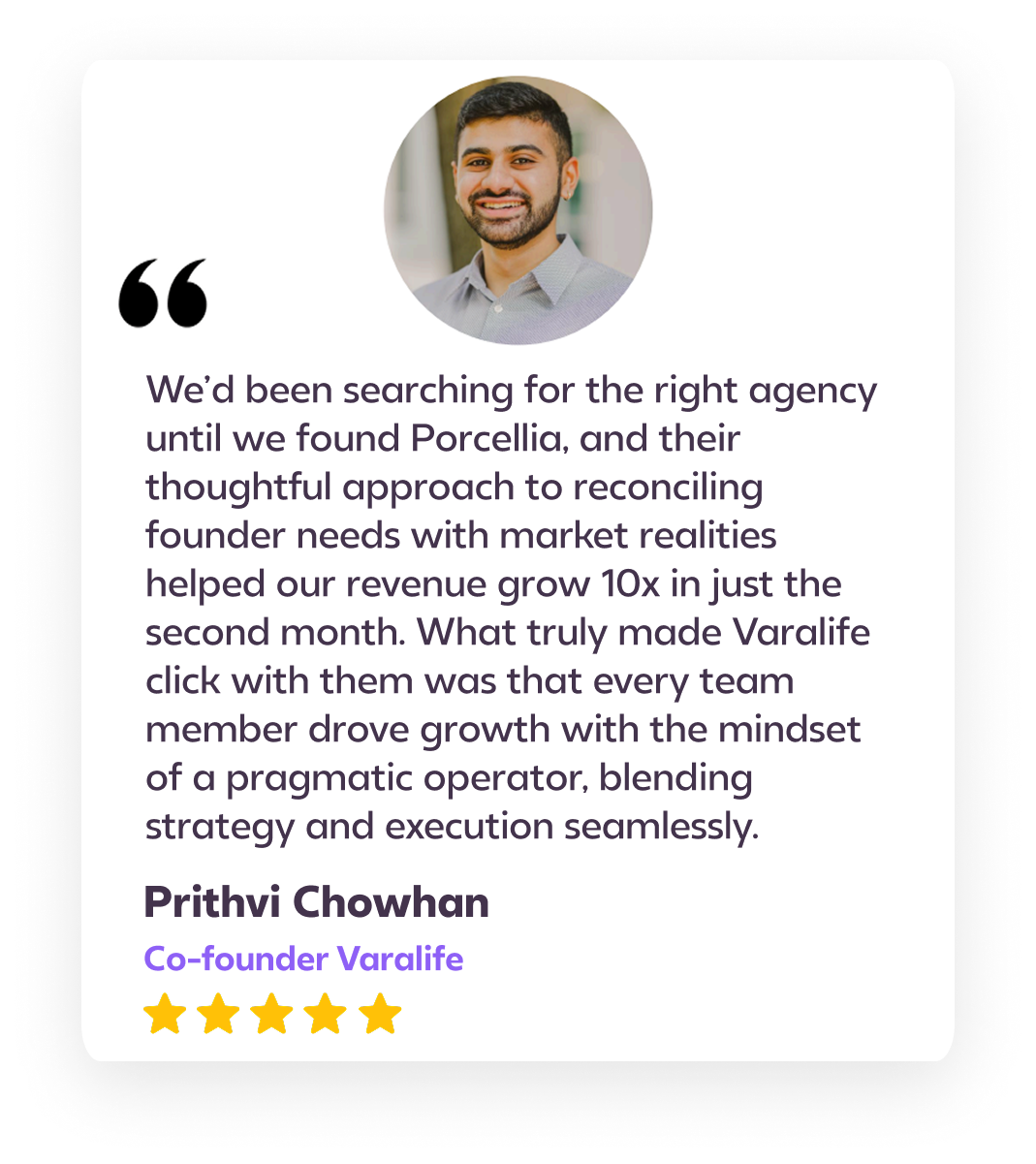
Varalife
Working with founders at that stage is electric.
Everything is uncertain.
Every experiment matters.
Every creative idea can change the trajectory of the company. And that environment forces creativity.
Which leads to a very important insight.
Every growth strategy we use with scaling brands today…was originally discovered while working with a smaller one.
Every creative framework. Every ad structure. Every positioning insight.
The need to do PR. The need to focus on retention. The need to get our creator strategy right.
It all started as a messy experiment in the 0 → 1 phase.
Small brands are the laboratory.
Scaling brands are where those ideas get refined and operationalized.
Which means if you stop working with early-stage companies…you slowly stop discovering new ideas.
And if you stop discovering new ideas…
eventually your strategies become stale.
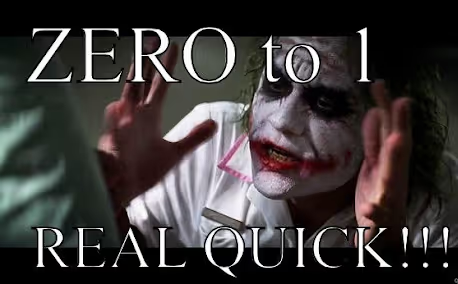
This is why we decided to intentionally move back into the 0 → 1 arena.
Not because we want to stop working with scaling brands.
But because working with early-stage companies actually makes us better partners for scaling companies.
The experiments happen at 0 → 1.
The refinement happens at 1 → 10.
Both worlds strengthen each other.
So we built a new vertical inside Porcellia focused entirely on 0 → 1 brands.
The goal is extremely simple.
Take brands from roughly ₹1L → ₹15L/month within three months.
Fast experimentation. Aggressive creative testing. Rapid iteration.
This is where new growth ideas get discovered again.
And those ideas eventually make their way into the strategies we deploy for larger brands.
We’re starting this with a small cohort of companies.
If you're currently running a D2C brand doing roughly ₹1L–₹5L per month, you can join the waitlist below.
Infact, for the first time, we also encourage non D2C brands to apply.
Join the waitlist here 👉 PorcelliaLabs - Waitlist page

See you on the other side of the waitlist.
P.S. We have already completed a VERY successful 0-1 pilot with a brand called Truely Health and were able to 10x the company in less than 4 months of starting, at a significantly better MER than they were at before.
In a world optimized for speed and dopamine, meaning is the only thing that lasts.
Read the full storyIn a world optimized for speed and dopamine, meaning is the only thing that lasts.
Read the full story
Get your hands on the the stuff that actually compounds.
Positioning. Retention. Content. Community.

Welcome to Finsweet's accessible modal component for Webflow Libraries. This modal uses Webflow Interactions to open and close. It is accessible through custom attributes and custom JavaScript added in the embed block of the component. If you're interested in how this is built, check out the Attributes documentation page for this modal component.
See docs