

%20(1).png)
There is a strange paradox in Indian D2C. A brand can go from ₹5 lakh a month to ₹20 lakh a month in revenue and somehow become a worse business in the process. Revenue goes up, customer count goes up, ad spend goes up—and yet the founder feels like the business is getting harder to run every month.
The usual explanation is CAC. Meta is getting expensive. CPMs are rising. Competition is increasing. Creative fatigues faster. Customers have more choices.
All of that is true. But I don't think Indian D2C has a CAC problem. I think it has a growth-system problem.
The distinction matters because acquisition is still the most important thing a D2C business needs to do. Without customers, nothing else matters. The problem is not that brands are focusing on acquisition. The problem is that they are trying to scale acquisition without building the economic engine underneath it that makes continued acquisition possible.
And when acquisition gets more expensive—as it inevitably does—the weakness becomes visible. Let's make this concrete.
Imagine two brands selling exactly the same fibre supplement. The product sells for ₹1,500 and contains a 28-day supply. Both brands have the same product quality and the same COGS of ₹350 per order. They have access to the same market and the same Meta ecosystem. Both have good creative. Both can produce winning ads.
The difference is what they've built around acquisition.
Brand A is acquisition-first.
It has figured out how to acquire customers cheaply. Its effective AOV is ₹1,300 because it relies primarily on discounting. Its starting CAC is ₹500. It has limited landing-page variation, limited CRO, relatively limited retention infrastructure and no meaningful product expansion.
Brand B has built a growth system around its acquisition engine.
Its starting CAC is actually much higher at ₹900. But it has engineered its offers to maintain a ₹1,500 AOV, built multiple hyper-relevant landing pages, aggressively tests conversion, invests heavily in retention and keeps expanding its product portfolio.
It also reaches more unique people without simply increasing frequency.
Here is what the two businesses look like:
If you looked only at CAC, Brand A would be the obvious winner.
And at low spend, it actually is.
That is important because this isn't a simulation designed to prove that a higher CAC is somehow better. It isn't.
At the beginning, cheap acquisition wins. The problem starts when you try to scale it.
Let's say both brands spend ₹5 lakh a month.
Brand A has a ₹500 CAC, so it acquires 1,000 customers.
Brand B has a ₹900 CAC, so it acquires roughly 556 customers.
Brand A is acquiring almost twice as many customers with the same amount of money.
If you are looking at the business through the lens of acquisition efficiency, there isn't much of a debate.
Brand A wins.
And this is exactly why the ₹500 CAC trap is so powerful.
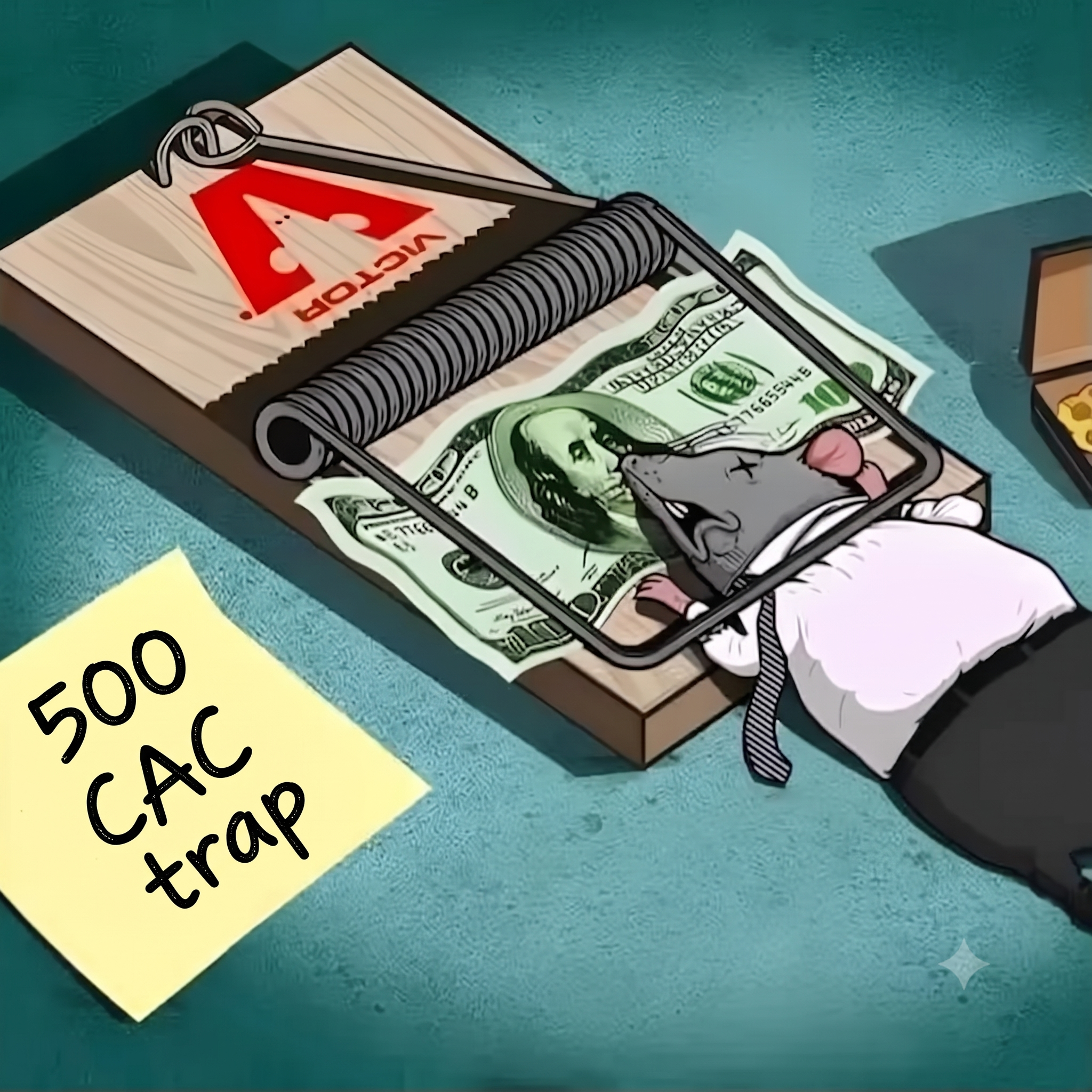
A founder sees a ₹500 CAC and thinks: We've figured it out.
The performance team is happy. The agency is happy. ROAS looks good. More money can be pushed into the account.
Then the business starts optimising around that number.
Get CAC down.
Find cheaper audiences.
Scale the winning creative.
Push more spend into the campaign.
Find another ₹50 of efficiency.
The problem is that the customer doesn't stop existing after the first purchase.
A ₹500 CAC tells you what you paid to acquire the customer.
It doesn't tell you what that customer will eventually be worth.
So let's follow the customer.
Brand A's effective AOV is ₹1,300.
Its M3 repeat rate is 30%, and its M6 repeat rate is 50%.
If we treat those as cumulative repeat-purchase rates, the average customer generates:
1 + 0.30 + 0.50 = 1.80 orders over six months.
At ₹1,300 AOV, that gives Brand A:
₹1,300 × 1.80 = ₹2,340 of six-month revenue per customer.
COGS is ₹350 per order, so six-month COGS is:
₹350 × 1.80 = ₹630.
At a ₹500 CAC, six-month CM2 is therefore:
₹2,340 − ₹630 − ₹500 = ₹1,210 per acquired customer.
That's a healthy number.
Now look at Brand B.
Its M3 repeat rate is 40% and its M6 repeat rate is 65%.
That gives:
1 + 0.40 + 0.65 = 2.05 orders over six months.
At a ₹1,500 AOV:
₹1,500 × 2.05 = ₹3,075 of six-month revenue.
Six-month COGS is:
₹350 × 2.05 = ₹717.50.
Subtract its much higher ₹900 CAC:
₹3,075 − ₹717.50 − ₹900 = ₹1,457.50.
So the ₹900 customer is actually generating more six-month CM2 than the ₹500 customer.
Brand A generates ₹1,210.
Brand B generates ₹1,457.50.
But here's where the argument becomes much more interesting.
Because we haven't scaled yet.
This is where the market starts doing what markets do. Brand A's CAC doesn't stay at ₹500. It rises to approximately ₹1,000.
Brand B's CAC rises too—from ₹900 to approximately ₹1,100. This is important. Brand B is not winning because its CAC stays flat.It doesn't.
Both businesses face rising acquisition costs.
Both have to pay more to acquire the next customer.
The difference is what happens to the economics around that customer.
At ₹20 lakh a month, Brand A acquires:
₹20,00,000 ÷ ₹1,000 = 2,000 customers.
Its six-month CM2 per customer is now:
₹2,340 − ₹630 − ₹1,000 = ₹710.
So the six-month contribution generated by that acquired cohort is:
2,000 × ₹710 = ₹14.2 lakh.
Now Brand B.
At a ₹1,100 CAC:
₹20,00,000 ÷ ₹1,100 ≈ 2,222 customers.
Its six-month CM2 per customer is:
₹3,075 − ₹717.50 − ₹1,100 = ₹1,257.50.
That gives:
2,222 × ₹1,257.50 ≈ ₹27.94 lakh.
So at ₹20 lakh of monthly acquisition spend, Brand B generates almost 2× the six-month CM2 of Brand A. And remember where the businesses started.
At ₹5 lakh a month, Brand A was clearly ahead.
At ₹20 lakh, Brand B is dramatically ahead.
Nothing magical happened to CAC. In fact, Brand B's CAC went up too. What changed was the system around acquisition.
The point isn't that Brand B has a more valuable customer. That's true, but it isn't the complete lesson. The important thing is that Brand B has built an engine that gives it the confidence to keep investing in acquisition. That is the entire purpose of the growth engine.
Acquisition is still the most important thing. In fact, if I had to choose between having an incredible acquisition engine and incredible retention with no acquisition engine, I'd take acquisition every time. A business needs customers before it can do anything else with them. But there is a difference between saying acquisition is the most important function and saying acquisition is the only function that matters.
Brand A is good at getting customers. Brand B has built a business that allows it to keep getting customers. That distinction becomes enormous as you scale.
When Brand A's CAC moves from ₹500 to ₹1,000, the founder starts getting nervous. The economics around the customer haven't changed enough to give the business much additional room. When Brand B's CAC moves from ₹900 to ₹1,100, the business still has headroom.
The founder knows that the customer is generating more revenue, buying more often and contributing more over time. That gives the acquisition engine room to keep operating.
The growth engine creates acquisition confidence.
And acquisition confidence is what allows you to scale.
This is why the obsession with cheap CAC can become dangerous. A ₹500 CAC is not bad. A low CAC is fantastic. The problem is believing that the lowest CAC automatically represents the strongest acquisition engine. It doesn't.
The strongest acquisition engine is the one that can continue acquiring customers profitably as you increase spend. At ₹5 lakh a month, Brand A's ₹500 CAC gives it a very real advantage. But if that CAC becomes ₹1,000 as the business scales, while the rest of the economics remain largely unchanged, the advantage disappears very quickly.
Brand B starts with a worse CAC. But it has built enough value around each acquired customer that when CAC rises, the acquisition engine still works. This is the ₹500 CAC trap.
Brands that scale aren't necessarily the brands with the lowest CAC. They are the brands that can keep acquiring customers when CAC is no longer low.
That is a much higher bar.
Think about what happens in an acquisition-only business. Every month, you have to find more people who haven't bought from you yet.
The easiest customers get acquired first.
Then you need to reach slightly colder customers.
Then broader audiences.
Then more expensive inventory.
Then more creative.
Then more spend.
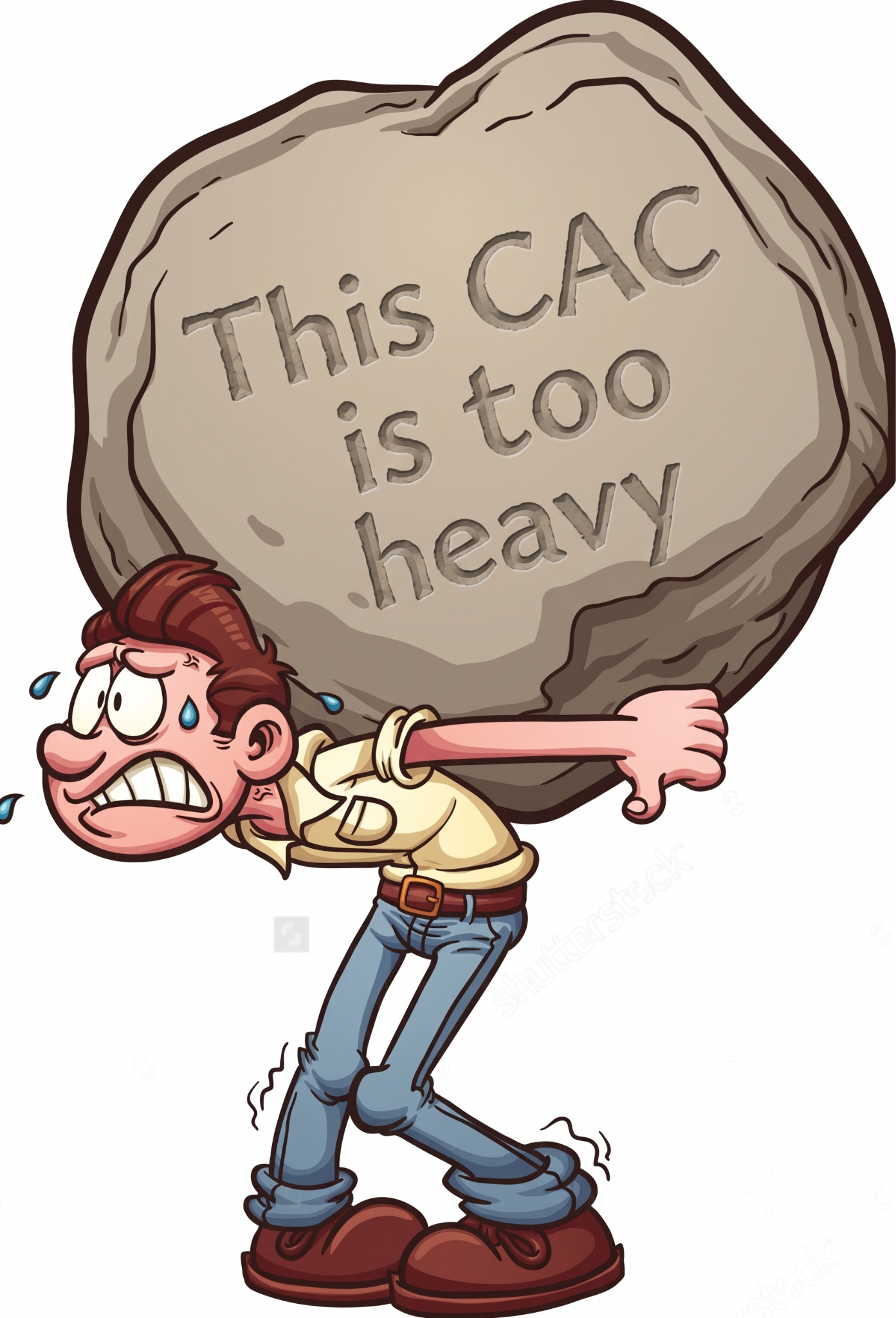
And if the economics of the customer don't improve alongside that process, the business becomes progressively harder to scale. This is why founders often feel that a brand becomes strangely difficult somewhere between ₹10 lakh, ₹20 lakh and ₹50 lakh a month.
The acquisition team hasn't suddenly become incompetent. The ads haven't necessarily stopped working. The business has simply reached the point where CAC is no longer being subsidised by everything else around the customer.
A growth engine changes that. It doesn't stop CAC from rising. It makes rising CAC survivable. And eventually, it can make higher CAC attractive because the business has become better at monetising every customer it acquires.
That is the real job of the system.
This is also where I think D2C founders need to change what they obsess over. Most businesses look at CAC, ROAS and first-order contribution because those numbers are available immediately. They're useful.
But they can also be incredibly misleading. If you're building a business with meaningful repeat purchase, the more important question is:
What is the six-month CM2 of the customer I'm acquiring?
And then:
What is the twelve-month CM2?
These numbers tell you something CAC cannot. They tell you how much economic value the acquisition engine is actually creating.
Imagine two businesses.
One acquires customers at ₹600 CAC.
Another acquires them at ₹900 CAC.
The first business looks better until you discover that its twelve-month CM2 is ₹700 while the second business's twelve-month CM2 is ₹2,500. The ₹600 CAC business isn't cheaper. It is simply worse at monetising the customer. This is why I would much rather know the six-month and twelve-month CM2 of a cohort than look at a single month's CAC in isolation.
Because ultimately, the founder's question shouldn't be:
"How cheaply did we acquire this customer?"
It should be:
"How much can we afford to spend to acquire this customer?"
Those are very different questions.
And the answer to the second one comes from the growth engine.
There is another important implication in the simulation. We aren't assuming Brand A has terrible performance marketing. It doesn't. Brand A can have a fantastic ad. In fact, let's say its best-performing ad generates a ₹1,300 AOV and a ₹300 CAC. That's roughly 4.3× ROAS.
Brand B can also have a fantastic ad. Its offer stacking gets AOV to roughly ₹1,800, while its hyper-relevant landing-page experience gets CAC down to ₹300–₹400. It can generate 4×+ ROAS too. So this isn't a story about one brand having a great performance team and the other having a bad one.
Both can acquire customers effectively. The difference is what happens to the business after acquisition. And that matters because acquisition doesn't happen once. You have to keep doing it.
The brand that can create more economic value from each acquired customer has more room to put money back into the acquisition engine.
It can spend more.
Test more.
Enter broader audiences.
Take more risks.
Survive a bad month.
Survive a period of creative fatigue.
And keep going.
That is what a growth engine buys you. Not better vanity metrics. More acquisition confidence.
A lot of American D2C brands have already been through this transition. The early growth phase was heavily acquisition-driven. Brands found audiences, found winning creative, scaled paid media and grew quickly. Then acquisition became more expensive. Competition increased. Creative fatigue became more pronounced.
The brands that continued scaling had to become better businesses around the customer.
They needed stronger LTV.
They needed better offers.
They needed better retention.
They needed more products.
They needed stronger customer relationships.
Not because acquisition stopped mattering.
Because acquisition became harder.
The market forced the rest of the business to become good enough to support it. This is why the US is a useful time machine for Indian D2C. The exact brands and products are different. The consumers are different. The market dynamics are different.
But the underlying problem is familiar. At some point, you can no longer rely on the fact that you found a ₹500 customer. You have to build a business that can still acquire customers when that customer costs ₹700, ₹900 or ₹1,100. And that is where the growth system becomes the foundation of acquisition.
This is the part I think gets misunderstood most often. There is a tendency to frame this as a choice:
Do you focus on acquisition, or do you focus on retention, LTV and everything else?
That's the wrong question. You should absolutely focus on acquisition. Acquisition is the most important thing. But you should build the rest of the growth engine because you want to acquire more customers, not because you want to acquire fewer.
The growth engine exists to make acquisition more scalable. It increases the amount of value you can create from every customer. That increases the amount you can afford to spend acquiring the next customer. That gives you more room to scale.
And as you scale, the additional customers create more data, more learning and more opportunities to improve the system again. So the flywheel becomes:
Better customer economics → more acquisition headroom → more acquisition → more customers → more learning → better customer economics.
That is what compounding looks like in D2C. The acquisition engine is what brings customers into the business. The growth engine is what gives that acquisition engine room to keep running.
The question isn't:
"How do I get my CAC back to ₹500?"
Maybe you can.
Maybe you can't.
The question is: "If CAC becomes ₹1,000, will my business still want to acquire the customer?"
If the answer is no, you don't necessarily have a CAC problem. You have a problem with everything that determines what that customer is worth after you acquire them. And that is why some D2C brands become harder to scale every month.
They keep trying to make acquisition cheaper when they should also be making the customer more valuable.
They keep optimising the first transaction when they should be building the economics of the relationship.
They keep celebrating lower CAC when they should be asking whether their six-month CM2 and twelve-month CM2 are improving.
Because those are the numbers that ultimately tell you whether you have built an acquisition engine that can scale. The best D2C businesses aren't necessarily the ones that acquire customers most cheaply. They are the ones that can look at a rising CAC and still say: "Yes. Keep spending."
In a world optimized for speed and dopamine, meaning is the only thing that lasts.
Read the full storyIn a world optimized for speed and dopamine, meaning is the only thing that lasts.
Read the full story
Get your hands on the the stuff that actually compounds.
Positioning. Retention. Content. Community.

Welcome to Finsweet's accessible modal component for Webflow Libraries. This modal uses Webflow Interactions to open and close. It is accessible through custom attributes and custom JavaScript added in the embed block of the component. If you're interested in how this is built, check out the Attributes documentation page for this modal component.
See docs